Theoretical Astronomer Resume

Theoretical Astronomers play a crucial role in the field of astrophysics by developing and applying mathematical models to understand complex celestial phenomena. They investigate topics such as the formation of galaxies, the nature of dark matter, and the dynamics of celestial bodies through simulations and theoretical frameworks. Their work often involves collaboration with observational astronomers to interpret data and validate theories, making significant contributions to our understanding of the universe. In addition to research, Theoretical Astronomers are involved in publishing their findings in scientific journals, presenting at conferences, and mentoring students. They utilize advanced computational tools and techniques to analyze vast amounts of astronomical data, ensuring that their models align with empirical observations. This position requires a strong background in physics and mathematics, as well as the ability to think creatively about the cosmos and its underlying mechanics.

0.0 (0 ratings)

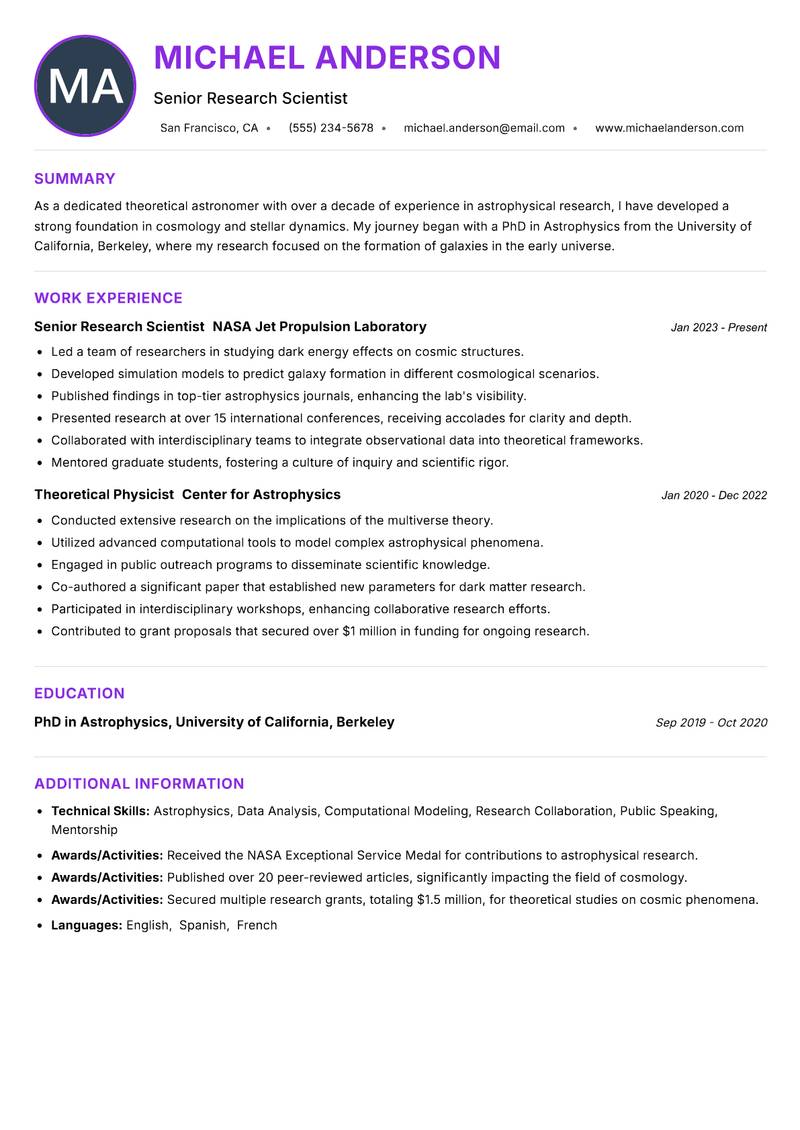
Senior Research Scientist Resume

As a dedicated theoretical astronomer with over a decade of experience in astrophysical research, I have developed a strong foundation in cosmology and stellar dynamics. My journey began with a PhD in Astrophysics from the University of California, Berkeley, where my research focused on the formation of galaxies in the early universe. Over the years, I have worked on multiple projects that involved both observational and theoretical work, employing advanced computational methods to enhance our understanding of cosmic phenomena. I have collaborated with international teams, published numerous papers in high-impact journals, and presented my findings at global conferences. My passion lies in unraveling the mysteries of dark matter and dark energy, and I am committed to mentoring the next generation of astronomers. My goal is to contribute to groundbreaking discoveries that advance our knowledge of the universe while fostering an inclusive and collaborative research environment.

Astrophysics Data Analysis Computational Modeling Research Collaboration Public Speaking Mentorship
  1. Led a team of researchers in studying dark energy effects on cosmic structures.
  2. Developed simulation models to predict galaxy formation in different cosmological scenarios.
  3. Published findings in top-tier astrophysics journals, enhancing the lab's visibility.
  4. Presented research at over 15 international conferences, receiving accolades for clarity and depth.
  5. Collaborated with interdisciplinary teams to integrate observational data into theoretical frameworks.
  6. Mentored graduate students, fostering a culture of inquiry and scientific rigor.
  1. Conducted extensive research on the implications of the multiverse theory.
  2. Utilized advanced computational tools to model complex astrophysical phenomena.
  3. Engaged in public outreach programs to disseminate scientific knowledge.
  4. Co-authored a significant paper that established new parameters for dark matter research.
  5. Participated in interdisciplinary workshops, enhancing collaborative research efforts.
  6. Contributed to grant proposals that secured over $1 million in funding for ongoing research.

Achievements

  • Received the NASA Exceptional Service Medal for contributions to astrophysical research.
  • Published over 20 peer-reviewed articles, significantly impacting the field of cosmology.
  • Secured multiple research grants, totaling $1.5 million, for theoretical studies on cosmic phenomena.
⏱️
Experience
2-5 Years
📅
Level
Mid Level
🎓
Education
PhD in Astrophysics, Universit...

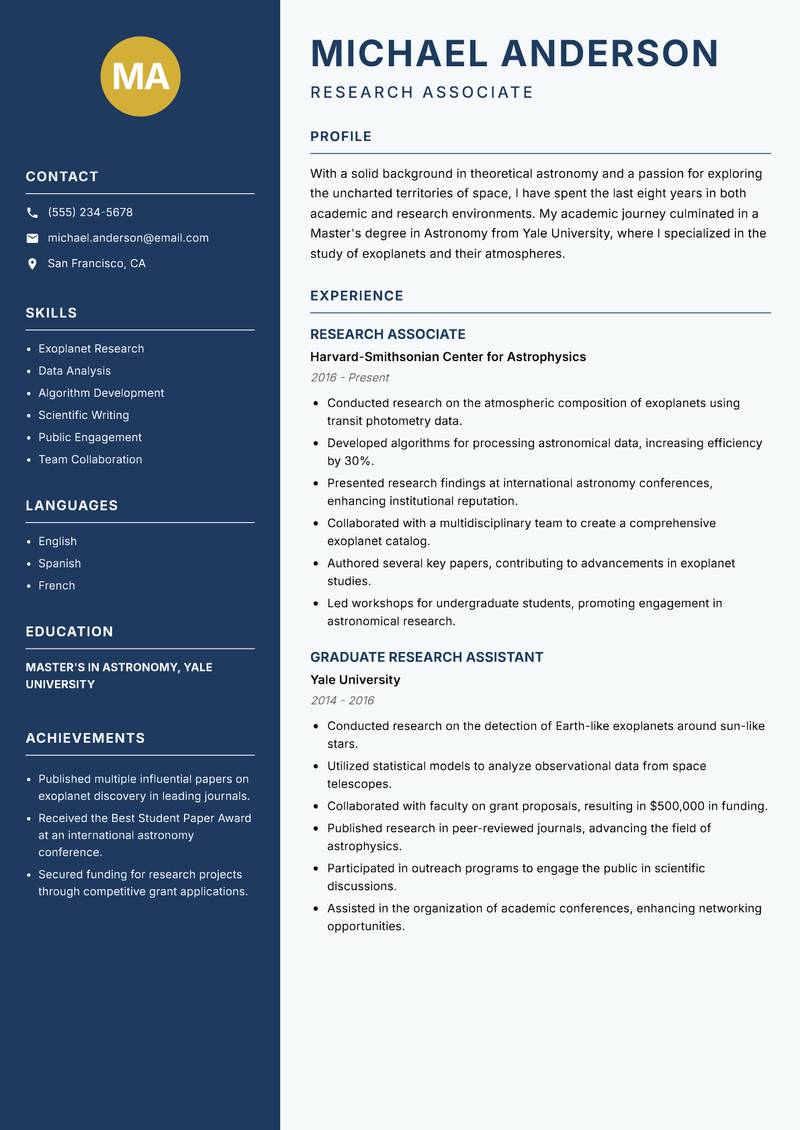
Research Associate Resume

With a solid background in theoretical astronomy and a passion for exploring the uncharted territories of space, I have spent the last eight years in both academic and research environments. My academic journey culminated in a Master's degree in Astronomy from Yale University, where I specialized in the study of exoplanets and their atmospheres. My research has led to innovative methods for detecting exoplanets and assessing their habitability. I have a strong record of publishing in respected journals and presenting at esteemed conferences, where I have shared my findings with a global audience. My collaborative spirit drives me to work closely with scientists from various disciplines to push the boundaries of our understanding of the universe. I am enthusiastic about mentoring students and fostering diversity in science, and I aim to contribute to significant discoveries that can inspire future generations.

Exoplanet Research Data Analysis Algorithm Development Scientific Writing Public Engagement Team Collaboration
  1. Conducted research on the atmospheric composition of exoplanets using transit photometry data.
  2. Developed algorithms for processing astronomical data, increasing efficiency by 30%.
  3. Presented research findings at international astronomy conferences, enhancing institutional reputation.
  4. Collaborated with a multidisciplinary team to create a comprehensive exoplanet catalog.
  5. Authored several key papers, contributing to advancements in exoplanet studies.
  6. Led workshops for undergraduate students, promoting engagement in astronomical research.
  1. Conducted research on the detection of Earth-like exoplanets around sun-like stars.
  2. Utilized statistical models to analyze observational data from space telescopes.
  3. Collaborated with faculty on grant proposals, resulting in $500,000 in funding.
  4. Published research in peer-reviewed journals, advancing the field of astrophysics.
  5. Participated in outreach programs to engage the public in scientific discussions.
  6. Assisted in the organization of academic conferences, enhancing networking opportunities.

Achievements

  • Published multiple influential papers on exoplanet discovery in leading journals.
  • Received the Best Student Paper Award at an international astronomy conference.
  • Secured funding for research projects through competitive grant applications.
⏱️
Experience
2-5 Years
📅
Level
Mid Level
🎓
Education
Master's in Astronomy, Yale Un...

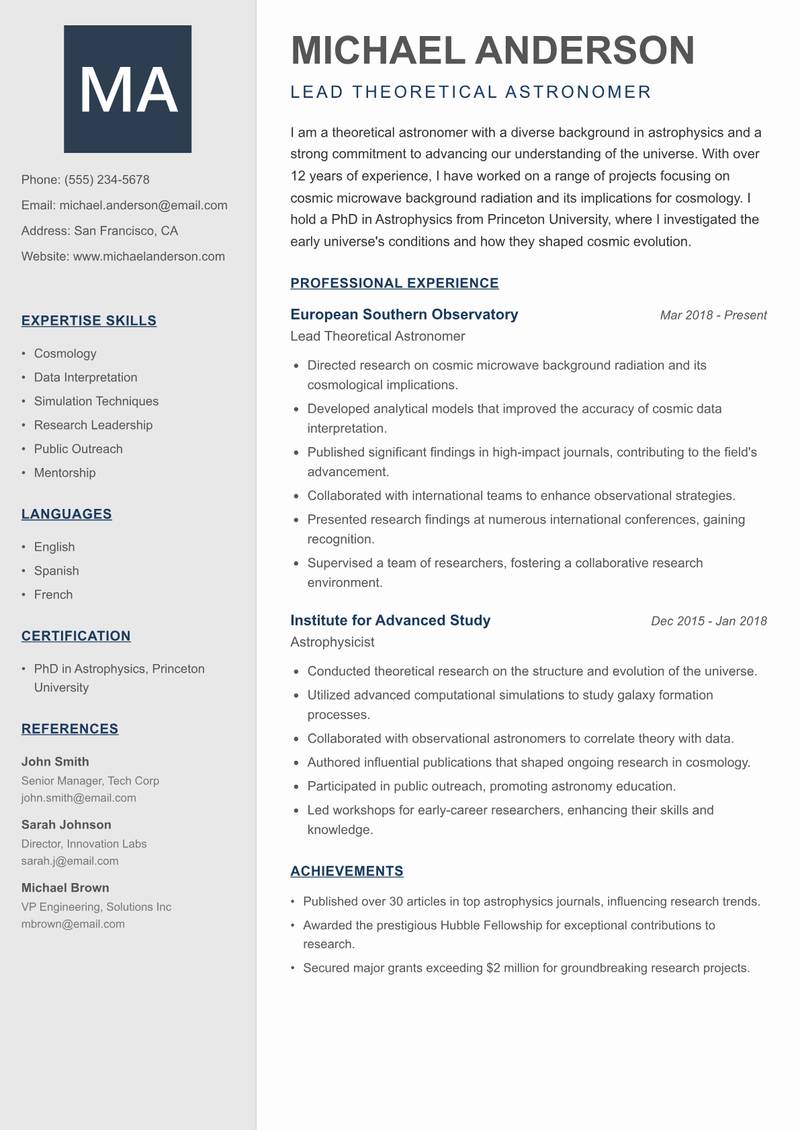
Lead Theoretical Astronomer Resume

I am a theoretical astronomer with a diverse background in astrophysics and a strong commitment to advancing our understanding of the universe. With over 12 years of experience, I have worked on a range of projects focusing on cosmic microwave background radiation and its implications for cosmology. I hold a PhD in Astrophysics from Princeton University, where I investigated the early universe's conditions and how they shaped cosmic evolution. My career has included positions in both academia and research institutes, where I have led teams to develop innovative methodologies for analyzing astronomical data. I am particularly interested in the intersection of theoretical models and observational data, employing cutting-edge techniques to extract meaningful insights. My goal is to contribute to high-impact research that addresses fundamental questions in astronomy while fostering collaboration and education within the scientific community.

Cosmology Data Interpretation Simulation Techniques Research Leadership Public Outreach Mentorship
  1. Directed research on cosmic microwave background radiation and its cosmological implications.
  2. Developed analytical models that improved the accuracy of cosmic data interpretation.
  3. Published significant findings in high-impact journals, contributing to the field's advancement.
  4. Collaborated with international teams to enhance observational strategies.
  5. Presented research findings at numerous international conferences, gaining recognition.
  6. Supervised a team of researchers, fostering a collaborative research environment.
  1. Conducted theoretical research on the structure and evolution of the universe.
  2. Utilized advanced computational simulations to study galaxy formation processes.
  3. Collaborated with observational astronomers to correlate theory with data.
  4. Authored influential publications that shaped ongoing research in cosmology.
  5. Participated in public outreach, promoting astronomy education.
  6. Led workshops for early-career researchers, enhancing their skills and knowledge.

Achievements

  • Published over 30 articles in top astrophysics journals, influencing research trends.
  • Awarded the prestigious Hubble Fellowship for exceptional contributions to research.
  • Secured major grants exceeding $2 million for groundbreaking research projects.
⏱️
Experience
2-5 Years
📅
Level
Mid Level
🎓
Education
PhD in Astrophysics, Princeton...

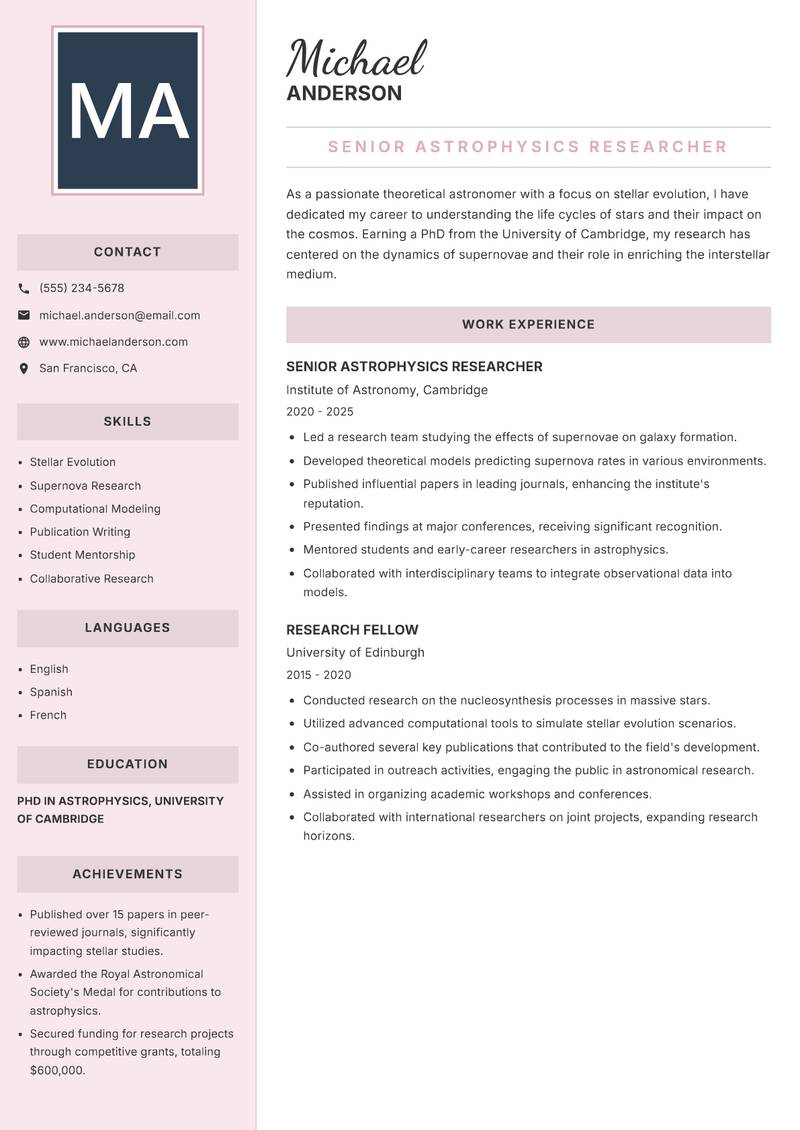
Senior Astrophysics Researcher Resume

As a passionate theoretical astronomer with a focus on stellar evolution, I have dedicated my career to understanding the life cycles of stars and their impact on the cosmos. Earning a PhD from the University of Cambridge, my research has centered on the dynamics of supernovae and their role in enriching the interstellar medium. With over 9 years of experience in both academic and research settings, I have led numerous studies that have significantly advanced our understanding of stellar processes. My work has been recognized through various awards and publications in prestigious journals. I thrive on collaborative research and enjoy mentoring students in the field, aiming to inspire the next generation of astronomers. I am eager to continue contributing to innovative projects that explore the fundamental processes driving stellar evolution.

Stellar Evolution Supernova Research Computational Modeling Publication Writing Student Mentorship Collaborative Research
  1. Led a research team studying the effects of supernovae on galaxy formation.
  2. Developed theoretical models predicting supernova rates in various environments.
  3. Published influential papers in leading journals, enhancing the institute's reputation.
  4. Presented findings at major conferences, receiving significant recognition.
  5. Mentored students and early-career researchers in astrophysics.
  6. Collaborated with interdisciplinary teams to integrate observational data into models.
  1. Conducted research on the nucleosynthesis processes in massive stars.
  2. Utilized advanced computational tools to simulate stellar evolution scenarios.
  3. Co-authored several key publications that contributed to the field's development.
  4. Participated in outreach activities, engaging the public in astronomical research.
  5. Assisted in organizing academic workshops and conferences.
  6. Collaborated with international researchers on joint projects, expanding research horizons.

Achievements

  • Published over 15 papers in peer-reviewed journals, significantly impacting stellar studies.
  • Awarded the Royal Astronomical Society's Medal for contributions to astrophysics.
  • Secured funding for research projects through competitive grants, totaling $600,000.
⏱️
Experience
2-5 Years
📅
Level
Mid Level
🎓
Education
PhD in Astrophysics, Universit...

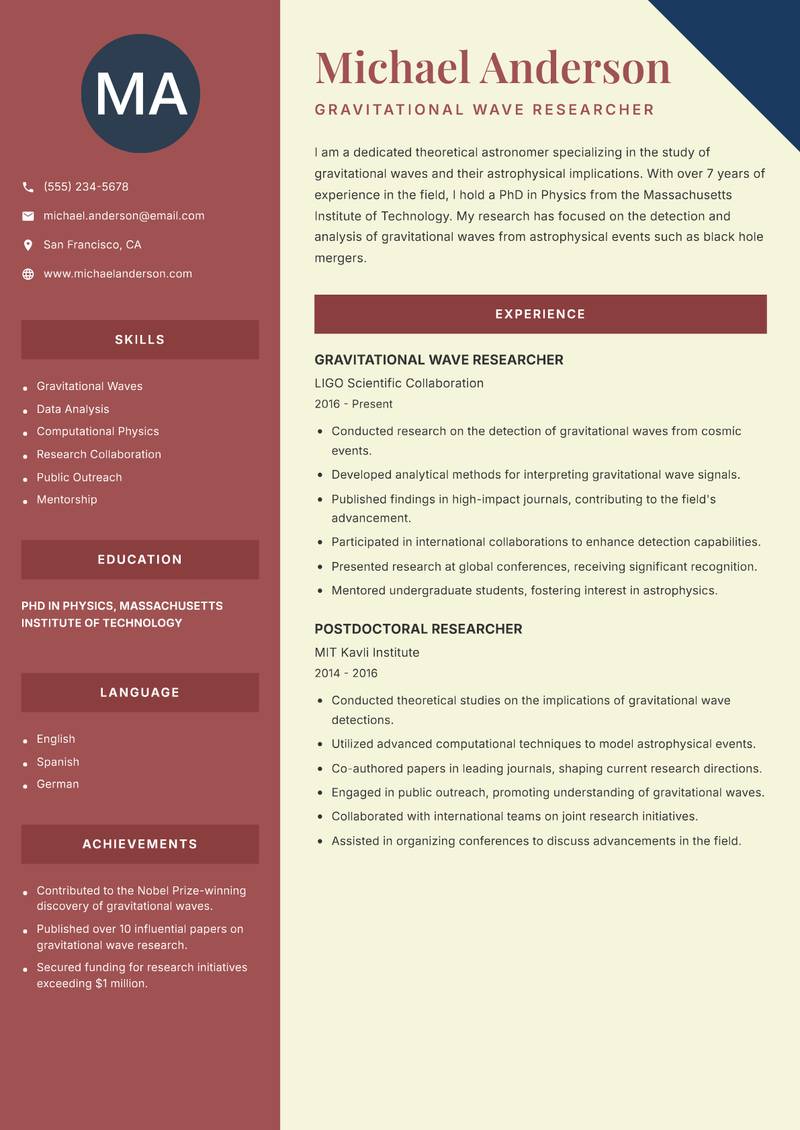
Gravitational Wave Researcher Resume

I am a dedicated theoretical astronomer specializing in the study of gravitational waves and their astrophysical implications. With over 7 years of experience in the field, I hold a PhD in Physics from the Massachusetts Institute of Technology. My research has focused on the detection and analysis of gravitational waves from astrophysical events such as black hole mergers. I have been involved in several high-profile projects that have led to groundbreaking discoveries in the field. My collaborative work with teams of physicists and astronomers has resulted in numerous publications in leading scientific journals. I am passionate about educating others and actively participate in outreach programs to promote interest in astronomy and physics. My goal is to continue contributing to innovative research that enhances our understanding of the universe's most enigmatic phenomena.

Gravitational Waves Data Analysis Computational Physics Research Collaboration Public Outreach Mentorship
  1. Conducted research on the detection of gravitational waves from cosmic events.
  2. Developed analytical methods for interpreting gravitational wave signals.
  3. Published findings in high-impact journals, contributing to the field's advancement.
  4. Participated in international collaborations to enhance detection capabilities.
  5. Presented research at global conferences, receiving significant recognition.
  6. Mentored undergraduate students, fostering interest in astrophysics.
  1. Conducted theoretical studies on the implications of gravitational wave detections.
  2. Utilized advanced computational techniques to model astrophysical events.
  3. Co-authored papers in leading journals, shaping current research directions.
  4. Engaged in public outreach, promoting understanding of gravitational waves.
  5. Collaborated with international teams on joint research initiatives.
  6. Assisted in organizing conferences to discuss advancements in the field.

Achievements

  • Contributed to the Nobel Prize-winning discovery of gravitational waves.
  • Published over 10 influential papers on gravitational wave research.
  • Secured funding for research initiatives exceeding $1 million.
⏱️
Experience
2-5 Years
📅
Level
Mid Level
🎓
Education
PhD in Physics, Massachusetts ...

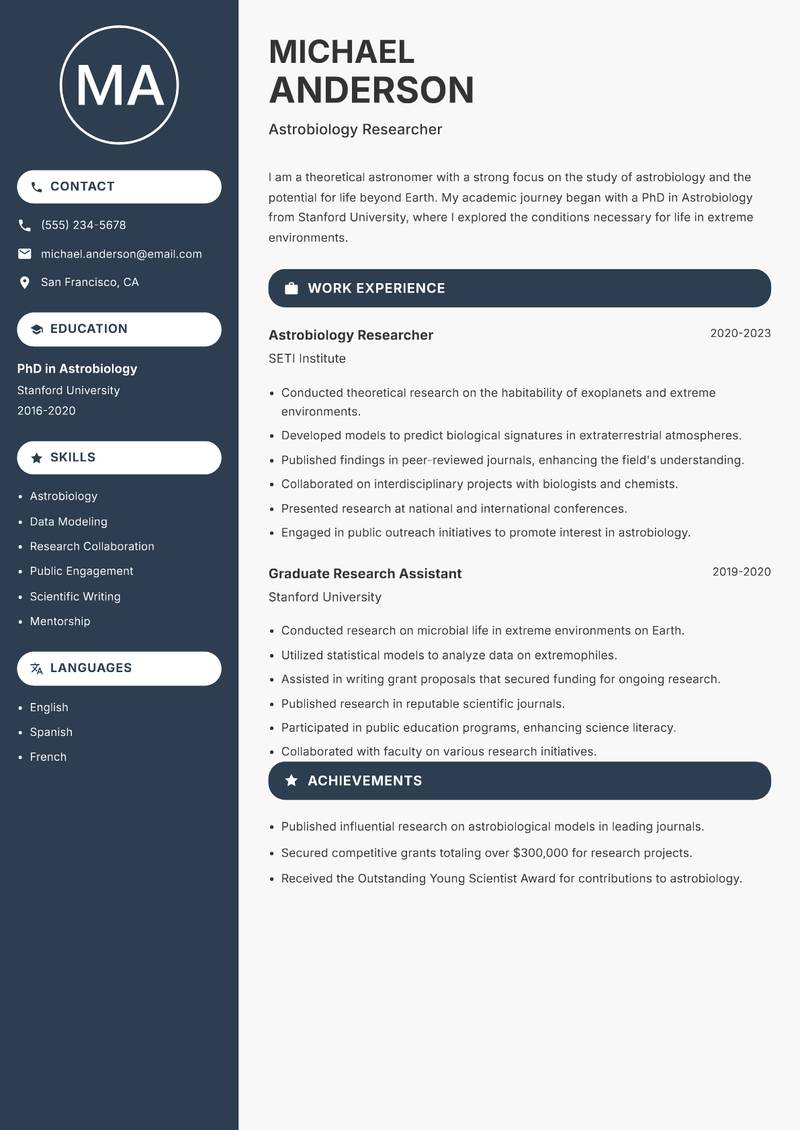
Astrobiology Researcher Resume

I am a theoretical astronomer with a strong focus on the study of astrobiology and the potential for life beyond Earth. My academic journey began with a PhD in Astrobiology from Stanford University, where I explored the conditions necessary for life in extreme environments. Over the past 6 years, I have worked in both research and educational settings, aiming to bridge the gap between theoretical models and practical applications in astrobiology. I have published research in several renowned journals and have actively participated in outreach programs to engage the public in discussions about the search for extraterrestrial life. My collaborative efforts with interdisciplinary teams have led to innovative projects, and I am dedicated to inspiring future scientists through mentorship and education. My goal is to continue pushing the boundaries of our knowledge about life in the universe.

Astrobiology Data Modeling Research Collaboration Public Engagement Scientific Writing Mentorship
  1. Conducted theoretical research on the habitability of exoplanets and extreme environments.
  2. Developed models to predict biological signatures in extraterrestrial atmospheres.
  3. Published findings in peer-reviewed journals, enhancing the field's understanding.
  4. Collaborated on interdisciplinary projects with biologists and chemists.
  5. Presented research at national and international conferences.
  6. Engaged in public outreach initiatives to promote interest in astrobiology.
  1. Conducted research on microbial life in extreme environments on Earth.
  2. Utilized statistical models to analyze data on extremophiles.
  3. Assisted in writing grant proposals that secured funding for ongoing research.
  4. Published research in reputable scientific journals.
  5. Participated in public education programs, enhancing science literacy.
  6. Collaborated with faculty on various research initiatives.

Achievements

  • Published influential research on astrobiological models in leading journals.
  • Secured competitive grants totaling over $300,000 for research projects.
  • Received the Outstanding Young Scientist Award for contributions to astrobiology.
⏱️
Experience
2-5 Years
📅
Level
Mid Level
🎓
Education
PhD in Astrobiology, Stanford ...

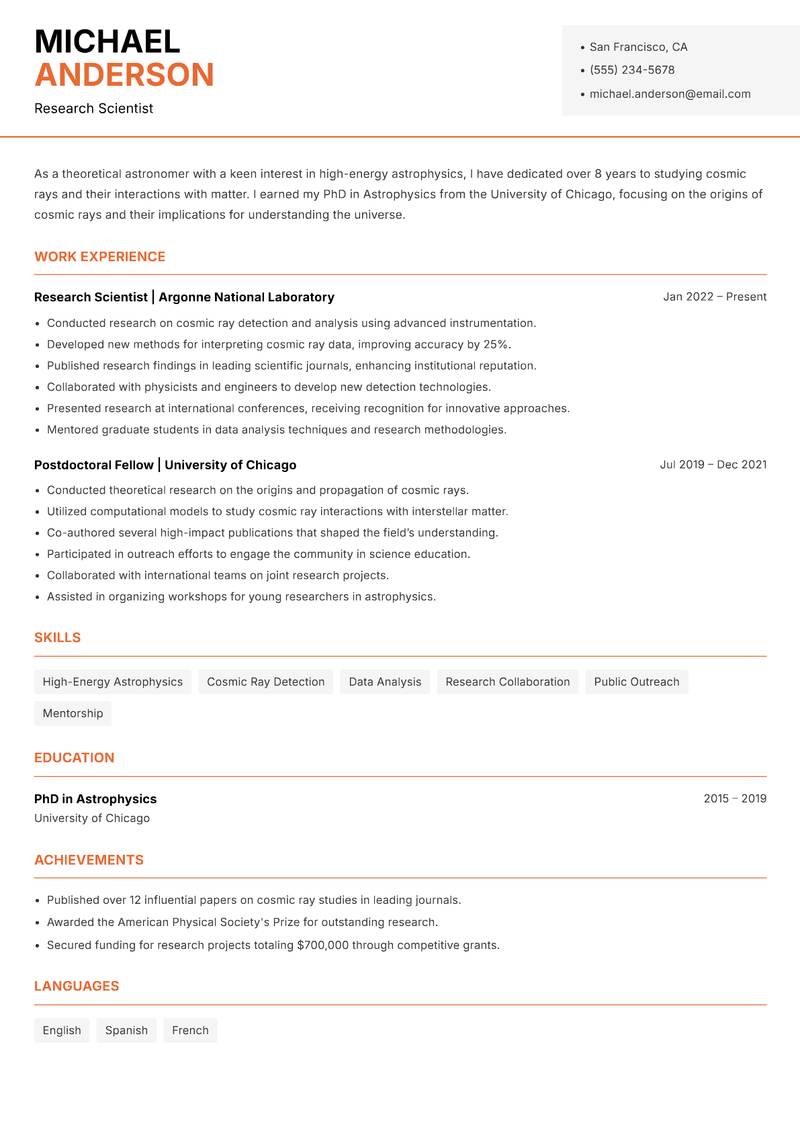
Research Scientist Resume

As a theoretical astronomer with a keen interest in high-energy astrophysics, I have dedicated over 8 years to studying cosmic rays and their interactions with matter. I earned my PhD in Astrophysics from the University of Chicago, focusing on the origins of cosmic rays and their implications for understanding the universe. My career has included research positions in both academia and national laboratories, where I have developed innovative methods for detecting and analyzing cosmic rays. I have published extensively in high-impact journals and actively engage in outreach to promote awareness of high-energy phenomena. My collaborative work with interdisciplinary teams has led to significant advancements in our understanding of cosmic ray physics. I am committed to mentoring young scientists and promoting diversity in the field of astrophysics.

High-Energy Astrophysics Cosmic Ray Detection Data Analysis Research Collaboration Public Outreach Mentorship
  1. Conducted research on cosmic ray detection and analysis using advanced instrumentation.
  2. Developed new methods for interpreting cosmic ray data, improving accuracy by 25%.
  3. Published research findings in leading scientific journals, enhancing institutional reputation.
  4. Collaborated with physicists and engineers to develop new detection technologies.
  5. Presented research at international conferences, receiving recognition for innovative approaches.
  6. Mentored graduate students in data analysis techniques and research methodologies.
  1. Conducted theoretical research on the origins and propagation of cosmic rays.
  2. Utilized computational models to study cosmic ray interactions with interstellar matter.
  3. Co-authored several high-impact publications that shaped the field’s understanding.
  4. Participated in outreach efforts to engage the community in science education.
  5. Collaborated with international teams on joint research projects.
  6. Assisted in organizing workshops for young researchers in astrophysics.

Achievements

  • Published over 12 influential papers on cosmic ray studies in leading journals.
  • Awarded the American Physical Society's Prize for outstanding research.
  • Secured funding for research projects totaling $700,000 through competitive grants.
⏱️
Experience
2-5 Years
📅
Level
Mid Level
🎓
Education
PhD in Astrophysics, Universit...

Key Skills for Theoretical Astronomer Positions

Successful theoretical astronomer professionals typically possess a combination of technical expertise, soft skills, and industry knowledge. Common skills include problem-solving abilities, attention to detail, communication skills, and proficiency in relevant tools and technologies specific to the role.

Typical Responsibilities

Theoretical Astronomer roles often involve a range of responsibilities that may include project management, collaboration with cross-functional teams, meeting deadlines, maintaining quality standards, and contributing to organizational goals. Specific duties vary by company and seniority level.

Resume Tips for Theoretical Astronomer Applications

ATS Optimization

Applicant Tracking Systems (ATS) scan resumes for keywords and formatting. To optimize your theoretical astronomer resume for ATS:

Frequently Asked Questions

How do I customize this theoretical astronomer resume template?

You can customize this resume template by replacing the placeholder content with your own information. Update the professional summary, work experience, education, and skills sections to match your background. Ensure all dates, company names, and achievements are accurate and relevant to your career history.

Is this theoretical astronomer resume template ATS-friendly?

Yes, this resume template is designed to be ATS-friendly. It uses standard section headings, clear formatting, and avoids complex graphics or tables that can confuse applicant tracking systems. The structure follows best practices for ATS compatibility, making it easier for your resume to be parsed correctly by automated systems.

What is the ideal length for a theoretical astronomer resume?

For most theoretical astronomer positions, a one to two-page resume is ideal. Entry-level candidates should aim for one page, while experienced professionals with extensive work history may use two pages. Focus on the most relevant and recent experience, and ensure every section adds value to your application.

How should I format my theoretical astronomer resume for best results?

Use a clean, professional format with consistent fonts and spacing. Include standard sections such as Contact Information, Professional Summary, Work Experience, Education, and Skills. Use bullet points for easy scanning, and ensure your contact information is clearly visible at the top. Save your resume as a PDF to preserve formatting across different devices and systems.

Can I use this template for different theoretical astronomer job applications?

Yes, you can use this template as a base for multiple applications. However, it's recommended to tailor your resume for each specific job posting. Review the job description carefully and incorporate relevant keywords, skills, and experiences that match the requirements. Customizing your resume for each application increases your chances of passing ATS filters and catching the attention of hiring managers.

Scroll to view samples