Cloud Observability Engineer Resume

As a Cloud Observability Engineer, you will play a crucial role in ensuring the reliability and performance of our cloud-based services. You will be responsible for implementing and managing observability solutions that provide real-time insights into system health, application performance, and user experience. Your expertise will help us proactively identify and resolve issues, ultimately enhancing our service delivery and customer satisfaction. In this position, you will collaborate closely with development, operations, and security teams to design and maintain observability frameworks. You will leverage tools such as Prometheus, Grafana, and ELK Stack to create dashboards, alerts, and reports that empower stakeholders with actionable data. Your analytical skills and technical knowledge will be essential in driving continuous improvement and ensuring our cloud environments are optimized for performance and availability.

0.0 (0 ratings)

Senior Cloud Observability Engineer Resume

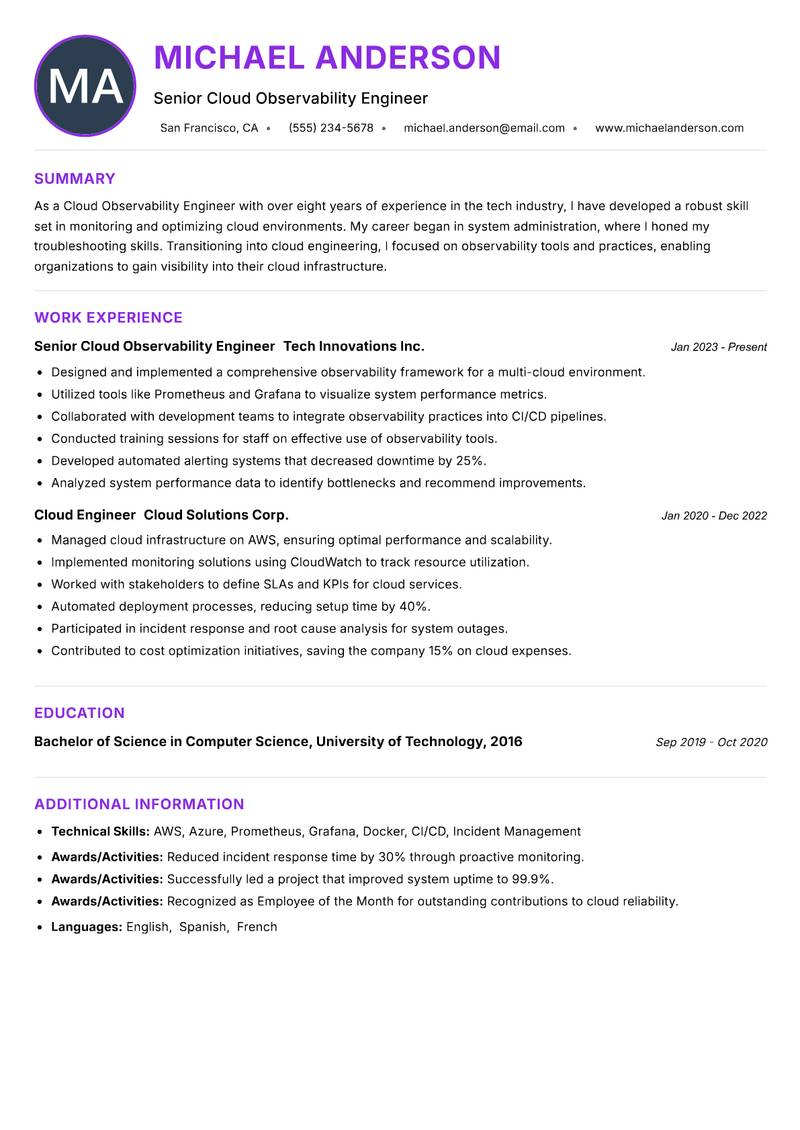
As a Cloud Observability Engineer with over eight years of experience in the tech industry, I have developed a robust skill set in monitoring and optimizing cloud environments. My career began in system administration, where I honed my troubleshooting skills. Transitioning into cloud engineering, I focused on observability tools and practices, enabling organizations to gain visibility into their cloud infrastructure. I have a proven track record of implementing monitoring solutions that enhance system reliability and performance. My hands-on experience with various cloud platforms, including AWS and Azure, allows me to tailor observability strategies that align with business objectives. In my recent role, I successfully led a project that integrated advanced monitoring tools, resulting in a 30% reduction in incident response time. I thrive in fast-paced environments and enjoy collaborating with cross-functional teams to drive continuous improvement. My goal is to leverage my expertise to foster a culture of observability and proactive incident management within organizations, ultimately enhancing system resilience and user satisfaction.

AWS Azure Prometheus Grafana Docker CI/CD Incident Management
  1. Designed and implemented a comprehensive observability framework for a multi-cloud environment.
  2. Utilized tools like Prometheus and Grafana to visualize system performance metrics.
  3. Collaborated with development teams to integrate observability practices into CI/CD pipelines.
  4. Conducted training sessions for staff on effective use of observability tools.
  5. Developed automated alerting systems that decreased downtime by 25%.
  6. Analyzed system performance data to identify bottlenecks and recommend improvements.
  1. Managed cloud infrastructure on AWS, ensuring optimal performance and scalability.
  2. Implemented monitoring solutions using CloudWatch to track resource utilization.
  3. Worked with stakeholders to define SLAs and KPIs for cloud services.
  4. Automated deployment processes, reducing setup time by 40%.
  5. Participated in incident response and root cause analysis for system outages.
  6. Contributed to cost optimization initiatives, saving the company 15% on cloud expenses.

Achievements

  • Reduced incident response time by 30% through proactive monitoring.
  • Successfully led a project that improved system uptime to 99.9%.
  • Recognized as Employee of the Month for outstanding contributions to cloud reliability.
⏱️
Experience
2-5 Years
📅
Level
Mid Level
🎓
Education
Bachelor of Science in Compute...

Cloud Observability Engineer Resume

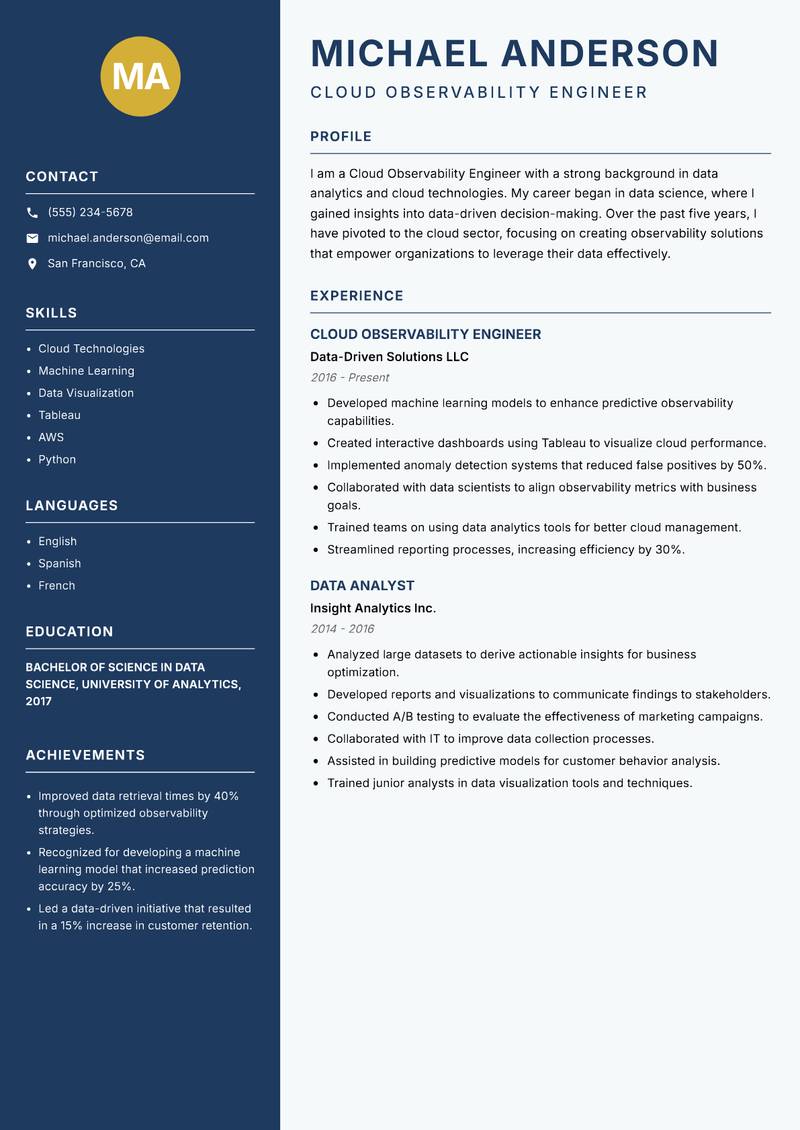
I am a Cloud Observability Engineer with a strong background in data analytics and cloud technologies. My career began in data science, where I gained insights into data-driven decision-making. Over the past five years, I have pivoted to the cloud sector, focusing on creating observability solutions that empower organizations to leverage their data effectively. My expertise lies in utilizing machine learning algorithms to predict system behavior and detect anomalies before they impact service delivery. I take pride in building dashboards and visualizations that simplify complex data, enabling stakeholders to make informed decisions quickly. In my most recent position, I implemented an observability strategy that improved data retrieval times by 40%. I am passionate about continuous learning and stay updated with the latest trends in cloud computing. My objective is to enhance cloud observability practices within organizations, ensuring that data is accessible and actionable.

Cloud Technologies Machine Learning Data Visualization Tableau AWS Python
  1. Developed machine learning models to enhance predictive observability capabilities.
  2. Created interactive dashboards using Tableau to visualize cloud performance.
  3. Implemented anomaly detection systems that reduced false positives by 50%.
  4. Collaborated with data scientists to align observability metrics with business goals.
  5. Trained teams on using data analytics tools for better cloud management.
  6. Streamlined reporting processes, increasing efficiency by 30%.
  1. Analyzed large datasets to derive actionable insights for business optimization.
  2. Developed reports and visualizations to communicate findings to stakeholders.
  3. Conducted A/B testing to evaluate the effectiveness of marketing campaigns.
  4. Collaborated with IT to improve data collection processes.
  5. Assisted in building predictive models for customer behavior analysis.
  6. Trained junior analysts in data visualization tools and techniques.

Achievements

  • Improved data retrieval times by 40% through optimized observability strategies.
  • Recognized for developing a machine learning model that increased prediction accuracy by 25%.
  • Led a data-driven initiative that resulted in a 15% increase in customer retention.
⏱️
Experience
2-5 Years
📅
Level
Mid Level
🎓
Education
Bachelor of Science in Data Sc...

Lead Cloud Observability Engineer Resume

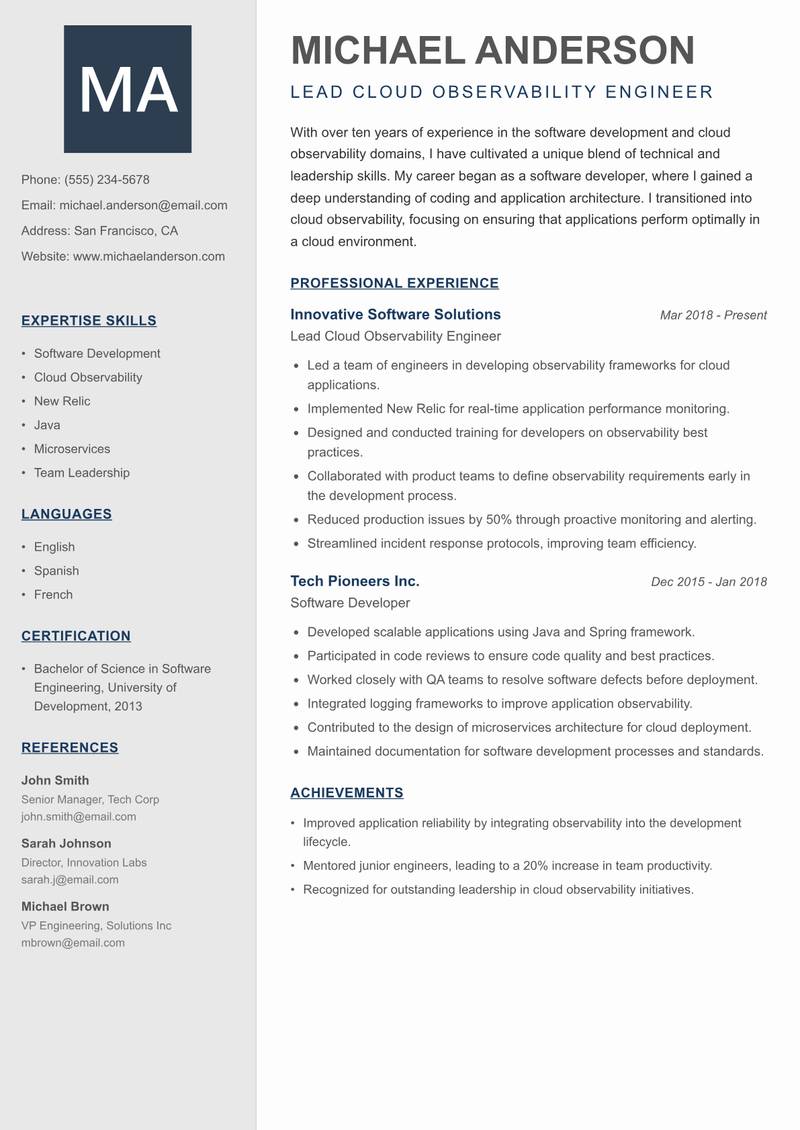
With over ten years of experience in the software development and cloud observability domains, I have cultivated a unique blend of technical and leadership skills. My career began as a software developer, where I gained a deep understanding of coding and application architecture. I transitioned into cloud observability, focusing on ensuring that applications perform optimally in a cloud environment. I have successfully led teams in implementing observability tools and practices, resulting in significant improvements in application reliability. My expertise includes working with tools such as New Relic and ELK stack to monitor application performance. In my previous role, I spearheaded a project that integrated observability into the development lifecycle, reducing production issues by 50%. I am passionate about mentoring junior engineers and promoting a culture of continuous improvement. My goal is to lead initiatives that enhance application observability, driving higher user satisfaction and operational excellence.

Software Development Cloud Observability New Relic Java Microservices Team Leadership
  1. Led a team of engineers in developing observability frameworks for cloud applications.
  2. Implemented New Relic for real-time application performance monitoring.
  3. Designed and conducted training for developers on observability best practices.
  4. Collaborated with product teams to define observability requirements early in the development process.
  5. Reduced production issues by 50% through proactive monitoring and alerting.
  6. Streamlined incident response protocols, improving team efficiency.
  1. Developed scalable applications using Java and Spring framework.
  2. Participated in code reviews to ensure code quality and best practices.
  3. Worked closely with QA teams to resolve software defects before deployment.
  4. Integrated logging frameworks to improve application observability.
  5. Contributed to the design of microservices architecture for cloud deployment.
  6. Maintained documentation for software development processes and standards.

Achievements

  • Improved application reliability by integrating observability into the development lifecycle.
  • Mentored junior engineers, leading to a 20% increase in team productivity.
  • Recognized for outstanding leadership in cloud observability initiatives.
⏱️
Experience
2-5 Years
📅
Level
Mid Level
🎓
Education
Bachelor of Science in Softwar...

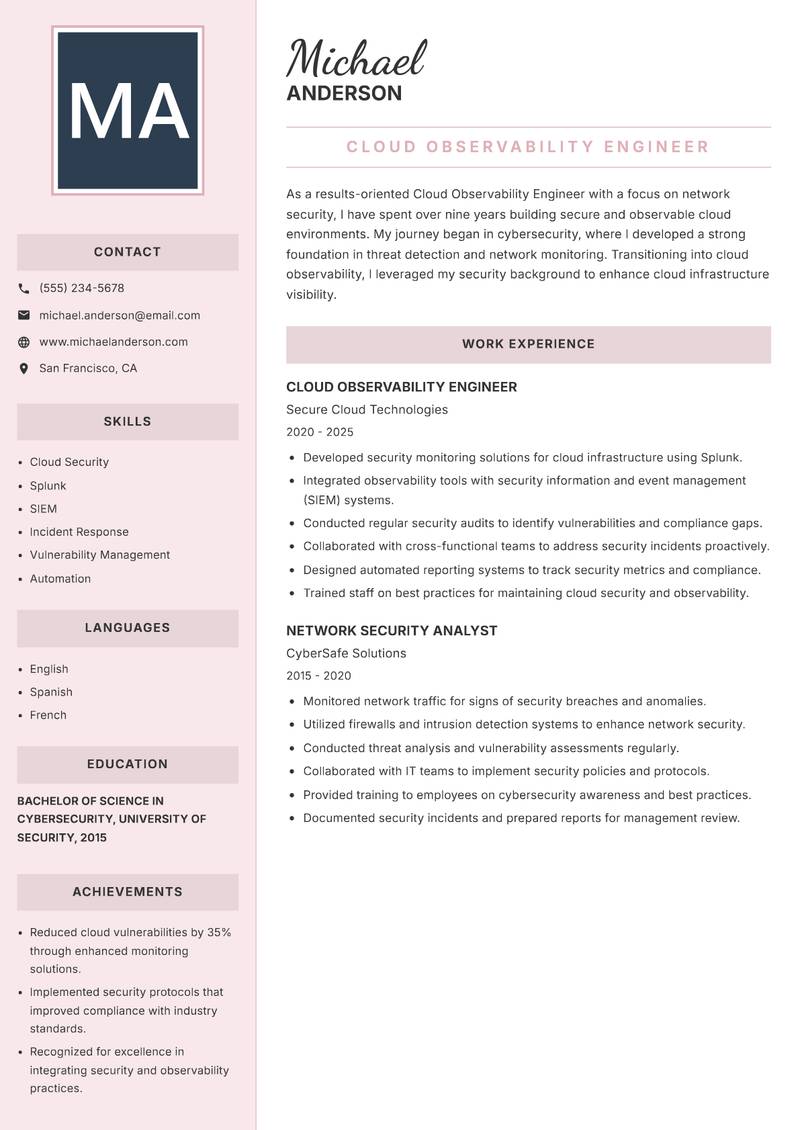
Cloud Observability Engineer Resume

As a results-oriented Cloud Observability Engineer with a focus on network security, I have spent over nine years building secure and observable cloud environments. My journey began in cybersecurity, where I developed a strong foundation in threat detection and network monitoring. Transitioning into cloud observability, I leveraged my security background to enhance cloud infrastructure visibility. I specialize in implementing observability practices that not only monitor performance but also ensure compliance with security standards. In my latest role, I implemented a security monitoring solution that reduced vulnerabilities by 35% and improved application security posture. I am dedicated to fostering collaboration between security and operations teams to enhance overall cloud security. My goal is to continue integrating observability and security practices to drive resilient and secure cloud environments.

Cloud Security Splunk SIEM Incident Response Vulnerability Management Automation
  1. Developed security monitoring solutions for cloud infrastructure using Splunk.
  2. Integrated observability tools with security information and event management (SIEM) systems.
  3. Conducted regular security audits to identify vulnerabilities and compliance gaps.
  4. Collaborated with cross-functional teams to address security incidents proactively.
  5. Designed automated reporting systems to track security metrics and compliance.
  6. Trained staff on best practices for maintaining cloud security and observability.
  1. Monitored network traffic for signs of security breaches and anomalies.
  2. Utilized firewalls and intrusion detection systems to enhance network security.
  3. Conducted threat analysis and vulnerability assessments regularly.
  4. Collaborated with IT teams to implement security policies and protocols.
  5. Provided training to employees on cybersecurity awareness and best practices.
  6. Documented security incidents and prepared reports for management review.

Achievements

  • Reduced cloud vulnerabilities by 35% through enhanced monitoring solutions.
  • Implemented security protocols that improved compliance with industry standards.
  • Recognized for excellence in integrating security and observability practices.
⏱️
Experience
2-5 Years
📅
Level
Mid Level
🎓
Education
Bachelor of Science in Cyberse...

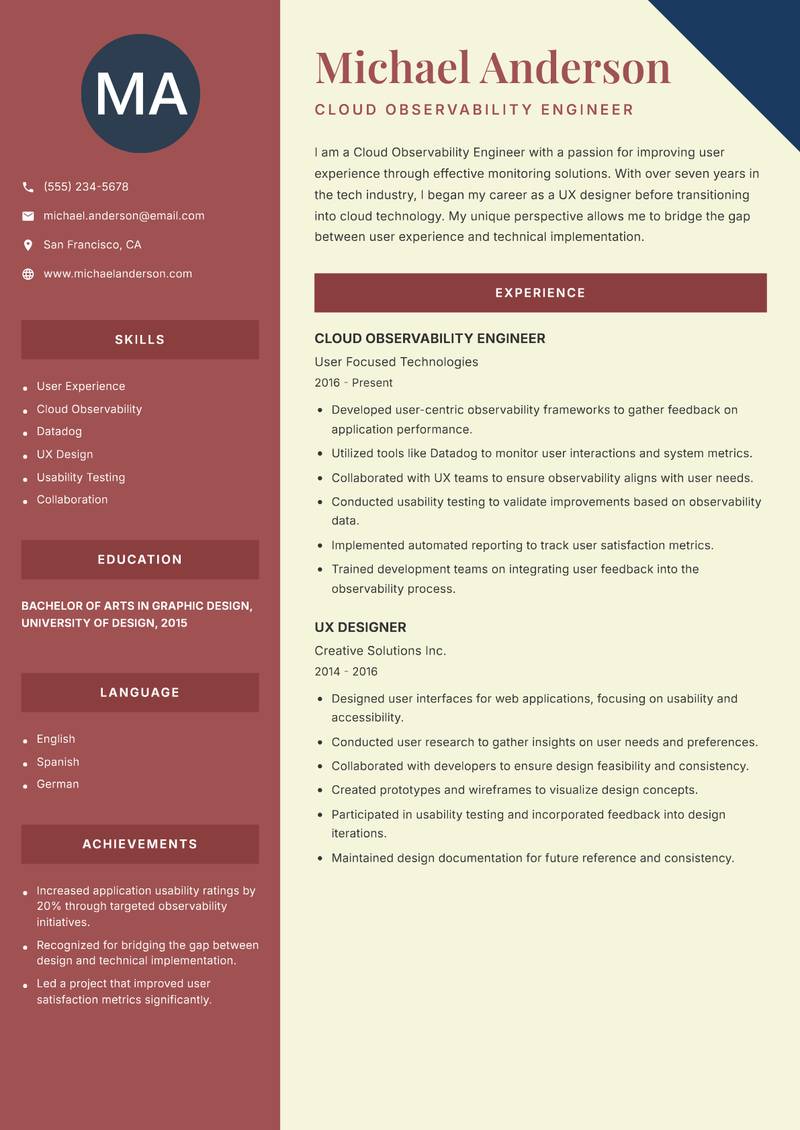
Cloud Observability Engineer Resume

I am a Cloud Observability Engineer with a passion for improving user experience through effective monitoring solutions. With over seven years in the tech industry, I began my career as a UX designer before transitioning into cloud technology. My unique perspective allows me to bridge the gap between user experience and technical implementation. I specialize in using observability tools to gather user feedback and system performance data, enabling organizations to make informed decisions about product enhancements. In my recent role, I implemented a user-centric observability framework that improved application usability ratings by 20%. I am dedicated to fostering collaboration between design and development teams to ensure that user needs are prioritized in the observability process. My goal is to continue advocating for user experience within cloud observability initiatives, enhancing both product functionality and user satisfaction.

User Experience Cloud Observability Datadog UX Design Usability Testing Collaboration
  1. Developed user-centric observability frameworks to gather feedback on application performance.
  2. Utilized tools like Datadog to monitor user interactions and system metrics.
  3. Collaborated with UX teams to ensure observability aligns with user needs.
  4. Conducted usability testing to validate improvements based on observability data.
  5. Implemented automated reporting to track user satisfaction metrics.
  6. Trained development teams on integrating user feedback into the observability process.
  1. Designed user interfaces for web applications, focusing on usability and accessibility.
  2. Conducted user research to gather insights on user needs and preferences.
  3. Collaborated with developers to ensure design feasibility and consistency.
  4. Created prototypes and wireframes to visualize design concepts.
  5. Participated in usability testing and incorporated feedback into design iterations.
  6. Maintained design documentation for future reference and consistency.

Achievements

  • Increased application usability ratings by 20% through targeted observability initiatives.
  • Recognized for bridging the gap between design and technical implementation.
  • Led a project that improved user satisfaction metrics significantly.
⏱️
Experience
2-5 Years
📅
Level
Mid Level
🎓
Education
Bachelor of Arts in Graphic De...

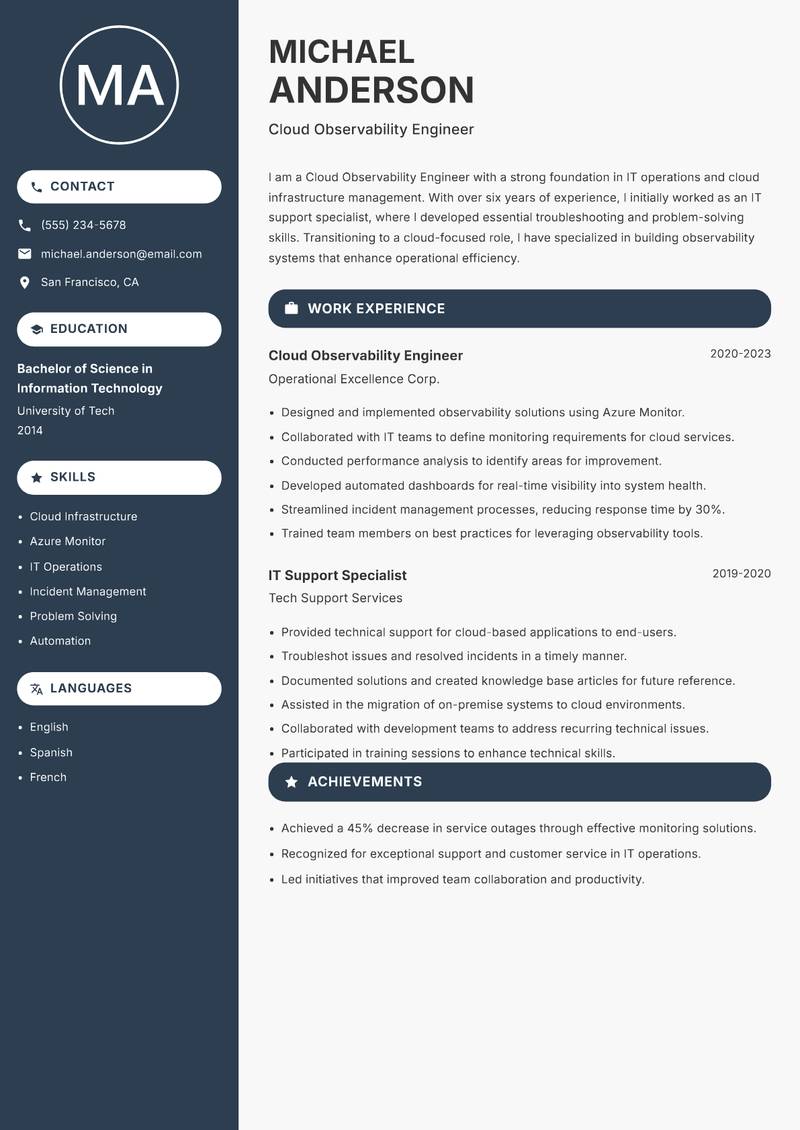
Cloud Observability Engineer Resume

I am a Cloud Observability Engineer with a strong foundation in IT operations and cloud infrastructure management. With over six years of experience, I initially worked as an IT support specialist, where I developed essential troubleshooting and problem-solving skills. Transitioning to a cloud-focused role, I have specialized in building observability systems that enhance operational efficiency. My expertise includes utilizing tools like Azure Monitor and ELK stack to provide visibility into application performance and infrastructure health. In my most recent position, I implemented monitoring solutions that led to a 45% decrease in service outages. I am passionate about leveraging technology to improve IT operations and am committed to continuous learning and professional development. My goal is to drive operational excellence through effective observability practices and collaboration with IT teams.

Cloud Infrastructure Azure Monitor IT Operations Incident Management Problem Solving Automation
  1. Designed and implemented observability solutions using Azure Monitor.
  2. Collaborated with IT teams to define monitoring requirements for cloud services.
  3. Conducted performance analysis to identify areas for improvement.
  4. Developed automated dashboards for real-time visibility into system health.
  5. Streamlined incident management processes, reducing response time by 30%.
  6. Trained team members on best practices for leveraging observability tools.
  1. Provided technical support for cloud-based applications to end-users.
  2. Troubleshot issues and resolved incidents in a timely manner.
  3. Documented solutions and created knowledge base articles for future reference.
  4. Assisted in the migration of on-premise systems to cloud environments.
  5. Collaborated with development teams to address recurring technical issues.
  6. Participated in training sessions to enhance technical skills.

Achievements

  • Achieved a 45% decrease in service outages through effective monitoring solutions.
  • Recognized for exceptional support and customer service in IT operations.
  • Led initiatives that improved team collaboration and productivity.
⏱️
Experience
2-5 Years
📅
Level
Mid Level
🎓
Education
Bachelor of Science in Informa...

Cloud Observability Engineer Resume

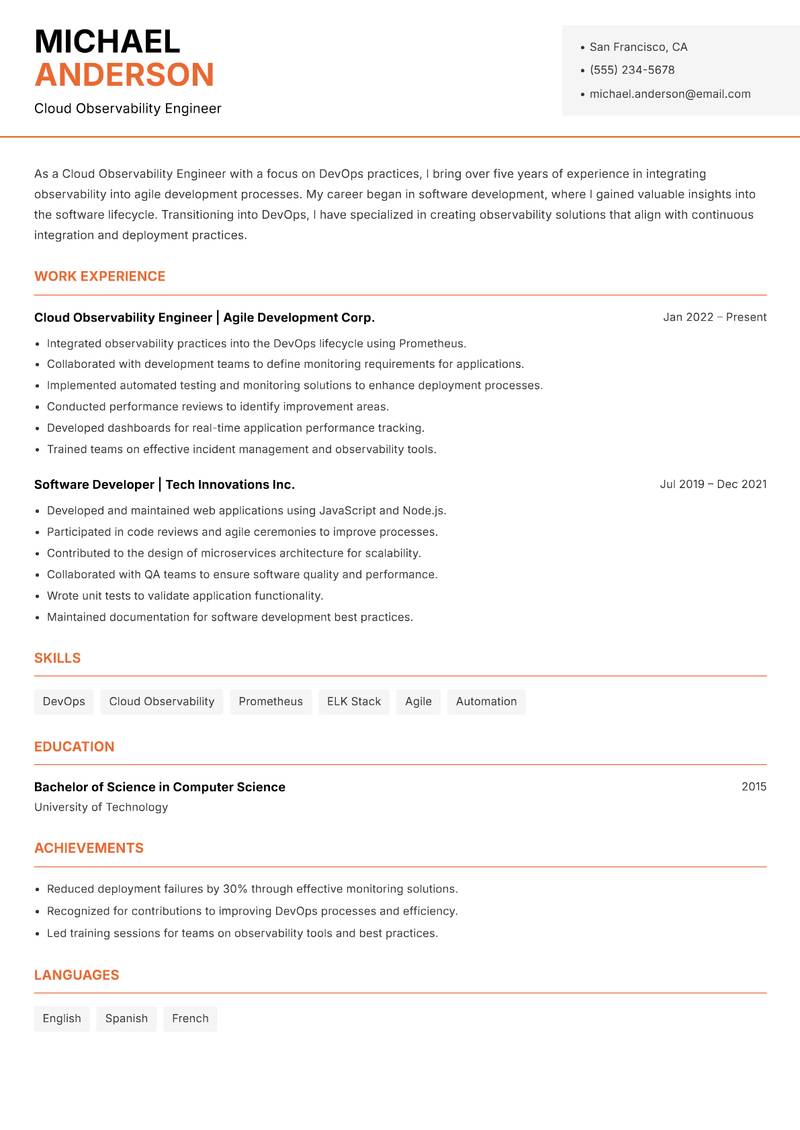
As a Cloud Observability Engineer with a focus on DevOps practices, I bring over five years of experience in integrating observability into agile development processes. My career began in software development, where I gained valuable insights into the software lifecycle. Transitioning into DevOps, I have specialized in creating observability solutions that align with continuous integration and deployment practices. My expertise includes utilizing tools such as Prometheus and ELK stack to monitor application performance and system health. In my previous role, I successfully implemented a monitoring solution that reduced deployment failures by 30%. I am dedicated to fostering a culture of observability within DevOps teams to enhance collaboration and ensure that systems are reliable and performant. My goal is to continue driving innovation in cloud observability, ultimately improving the development lifecycle and user experiences.

DevOps Cloud Observability Prometheus ELK Stack Agile Automation
  1. Integrated observability practices into the DevOps lifecycle using Prometheus.
  2. Collaborated with development teams to define monitoring requirements for applications.
  3. Implemented automated testing and monitoring solutions to enhance deployment processes.
  4. Conducted performance reviews to identify improvement areas.
  5. Developed dashboards for real-time application performance tracking.
  6. Trained teams on effective incident management and observability tools.
  1. Developed and maintained web applications using JavaScript and Node.js.
  2. Participated in code reviews and agile ceremonies to improve processes.
  3. Contributed to the design of microservices architecture for scalability.
  4. Collaborated with QA teams to ensure software quality and performance.
  5. Wrote unit tests to validate application functionality.
  6. Maintained documentation for software development best practices.

Achievements

  • Reduced deployment failures by 30% through effective monitoring solutions.
  • Recognized for contributions to improving DevOps processes and efficiency.
  • Led training sessions for teams on observability tools and best practices.
⏱️
Experience
2-5 Years
📅
Level
Mid Level
🎓
Education
Bachelor of Science in Compute...

Key Skills for Cloud Observability Engineer Positions

Successful cloud observability engineer professionals typically possess a combination of technical expertise, soft skills, and industry knowledge. Common skills include problem-solving abilities, attention to detail, communication skills, and proficiency in relevant tools and technologies specific to the role.

Typical Responsibilities

Cloud Observability Engineer roles often involve a range of responsibilities that may include project management, collaboration with cross-functional teams, meeting deadlines, maintaining quality standards, and contributing to organizational goals. Specific duties vary by company and seniority level.

Resume Tips for Cloud Observability Engineer Applications

ATS Optimization

Applicant Tracking Systems (ATS) scan resumes for keywords and formatting. To optimize your cloud observability engineer resume for ATS:

Frequently Asked Questions

How do I customize this cloud observability engineer resume template?

You can customize this resume template by replacing the placeholder content with your own information. Update the professional summary, work experience, education, and skills sections to match your background. Ensure all dates, company names, and achievements are accurate and relevant to your career history.

Is this cloud observability engineer resume template ATS-friendly?

Yes, this resume template is designed to be ATS-friendly. It uses standard section headings, clear formatting, and avoids complex graphics or tables that can confuse applicant tracking systems. The structure follows best practices for ATS compatibility, making it easier for your resume to be parsed correctly by automated systems.

What is the ideal length for a cloud observability engineer resume?

For most cloud observability engineer positions, a one to two-page resume is ideal. Entry-level candidates should aim for one page, while experienced professionals with extensive work history may use two pages. Focus on the most relevant and recent experience, and ensure every section adds value to your application.

How should I format my cloud observability engineer resume for best results?

Use a clean, professional format with consistent fonts and spacing. Include standard sections such as Contact Information, Professional Summary, Work Experience, Education, and Skills. Use bullet points for easy scanning, and ensure your contact information is clearly visible at the top. Save your resume as a PDF to preserve formatting across different devices and systems.

Can I use this template for different cloud observability engineer job applications?

Yes, you can use this template as a base for multiple applications. However, it's recommended to tailor your resume for each specific job posting. Review the job description carefully and incorporate relevant keywords, skills, and experiences that match the requirements. Customizing your resume for each application increases your chances of passing ATS filters and catching the attention of hiring managers.

Scroll to view samples