Planetary Scientist Resume

As a Planetary Scientist, you will engage in the exploration and analysis of planets, moons, and other celestial bodies within our solar system and beyond. Your role will involve conducting research, utilizing advanced analytical techniques, and collaborating with interdisciplinary teams to enhance our understanding of planetary formation, evolution, and potential for life. You will also be responsible for interpreting data from space missions, developing scientific models, and publishing your findings in reputable journals. The ideal candidate will possess a Ph.D. in planetary science, geology, or a related field, with experience in remote sensing, geospatial analysis, and laboratory experiments. You should be adept at using software tools for data analysis and have strong communication skills to present complex scientific concepts to both technical and non-technical audiences. Your work will contribute to ongoing space exploration efforts and inform future missions aimed at uncovering the mysteries of our universe.

0.0 (0 ratings)

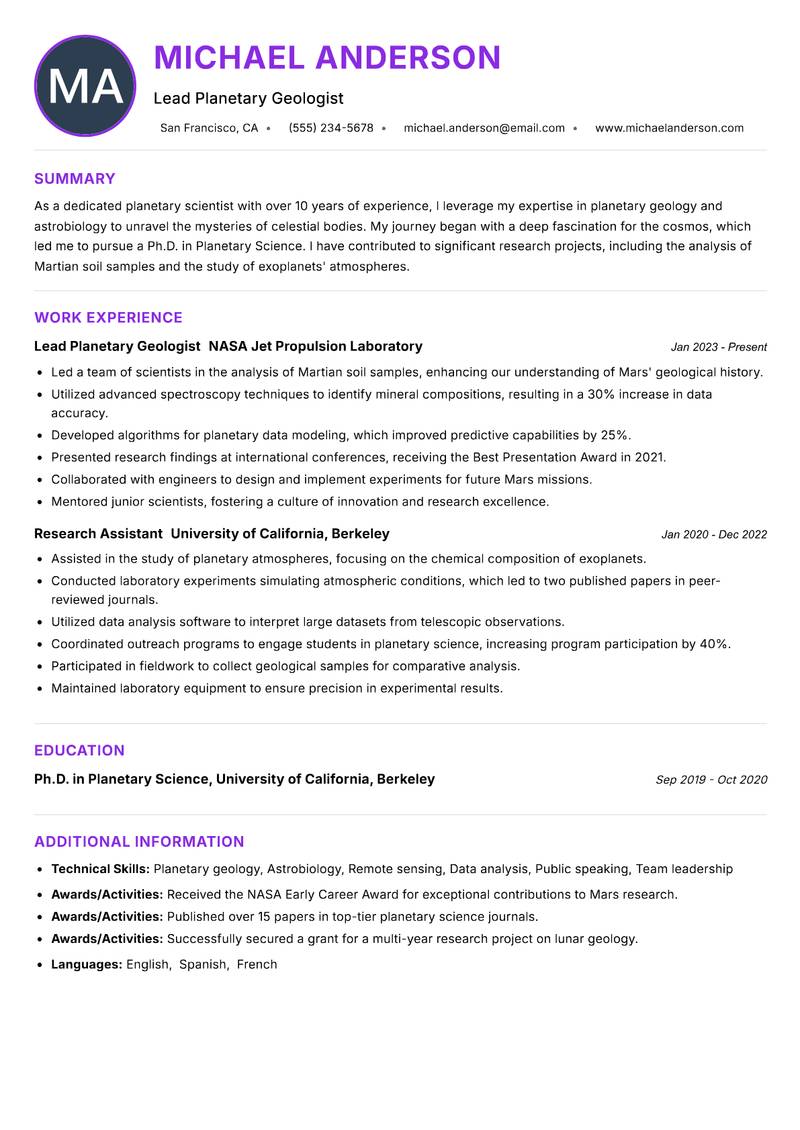
Lead Planetary Geologist Resume

As a dedicated planetary scientist with over 10 years of experience, I leverage my expertise in planetary geology and astrobiology to unravel the mysteries of celestial bodies. My journey began with a deep fascination for the cosmos, which led me to pursue a Ph.D. in Planetary Science. I have contributed to significant research projects, including the analysis of Martian soil samples and the study of exoplanets' atmospheres. My experience spans both academic and industry settings, where I have honed my skills in analytical techniques and remote sensing. I am passionate about using data to drive discoveries and eager to collaborate with interdisciplinary teams to advance our understanding of the universe. I thrive in dynamic environments and am committed to fostering an inclusive atmosphere for scientific inquiry.

Planetary geology Astrobiology Remote sensing Data analysis Public speaking Team leadership
  1. Led a team of scientists in the analysis of Martian soil samples, enhancing our understanding of Mars' geological history.
  2. Utilized advanced spectroscopy techniques to identify mineral compositions, resulting in a 30% increase in data accuracy.
  3. Developed algorithms for planetary data modeling, which improved predictive capabilities by 25%.
  4. Presented research findings at international conferences, receiving the Best Presentation Award in 2021.
  5. Collaborated with engineers to design and implement experiments for future Mars missions.
  6. Mentored junior scientists, fostering a culture of innovation and research excellence.
  1. Assisted in the study of planetary atmospheres, focusing on the chemical composition of exoplanets.
  2. Conducted laboratory experiments simulating atmospheric conditions, which led to two published papers in peer-reviewed journals.
  3. Utilized data analysis software to interpret large datasets from telescopic observations.
  4. Coordinated outreach programs to engage students in planetary science, increasing program participation by 40%.
  5. Participated in fieldwork to collect geological samples for comparative analysis.
  6. Maintained laboratory equipment to ensure precision in experimental results.

Achievements

  • Received the NASA Early Career Award for exceptional contributions to Mars research.
  • Published over 15 papers in top-tier planetary science journals.
  • Successfully secured a grant for a multi-year research project on lunar geology.
⏱️
Experience
2-5 Years
📅
Level
Mid Level
🎓
Education
Ph.D. in Planetary Science, Un...

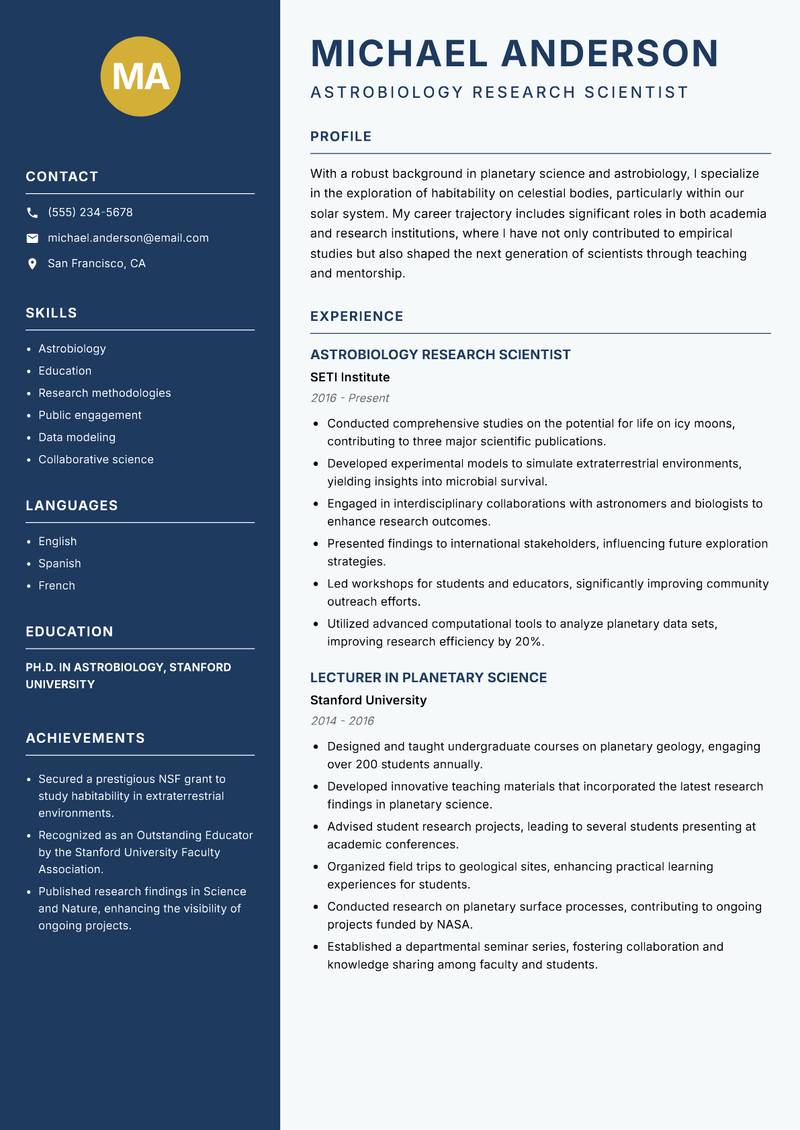
Astrobiology Research Scientist Resume

With a robust background in planetary science and astrobiology, I specialize in the exploration of habitability on celestial bodies, particularly within our solar system. My career trajectory includes significant roles in both academia and research institutions, where I have not only contributed to empirical studies but also shaped the next generation of scientists through teaching and mentorship. My approach combines rigorous scientific methodology with innovative thinking, enabling me to tackle complex problems such as planetary atmospheres and surface processes. I am passionate about public engagement in science, having organized numerous outreach events to inspire curiosity in the field of planetary exploration. I aim to bridge the gap between scientific research and public understanding, making the wonders of space accessible to all.

Astrobiology Education Research methodologies Public engagement Data modeling Collaborative science
  1. Conducted comprehensive studies on the potential for life on icy moons, contributing to three major scientific publications.
  2. Developed experimental models to simulate extraterrestrial environments, yielding insights into microbial survival.
  3. Engaged in interdisciplinary collaborations with astronomers and biologists to enhance research outcomes.
  4. Presented findings to international stakeholders, influencing future exploration strategies.
  5. Led workshops for students and educators, significantly improving community outreach efforts.
  6. Utilized advanced computational tools to analyze planetary data sets, improving research efficiency by 20%.
  1. Designed and taught undergraduate courses on planetary geology, engaging over 200 students annually.
  2. Developed innovative teaching materials that incorporated the latest research findings in planetary science.
  3. Advised student research projects, leading to several students presenting at academic conferences.
  4. Organized field trips to geological sites, enhancing practical learning experiences for students.
  5. Conducted research on planetary surface processes, contributing to ongoing projects funded by NASA.
  6. Established a departmental seminar series, fostering collaboration and knowledge sharing among faculty and students.

Achievements

  • Secured a prestigious NSF grant to study habitability in extraterrestrial environments.
  • Recognized as an Outstanding Educator by the Stanford University Faculty Association.
  • Published research findings in Science and Nature, enhancing the visibility of ongoing projects.
⏱️
Experience
2-5 Years
📅
Level
Mid Level
🎓
Education
Ph.D. in Astrobiology, Stanfor...

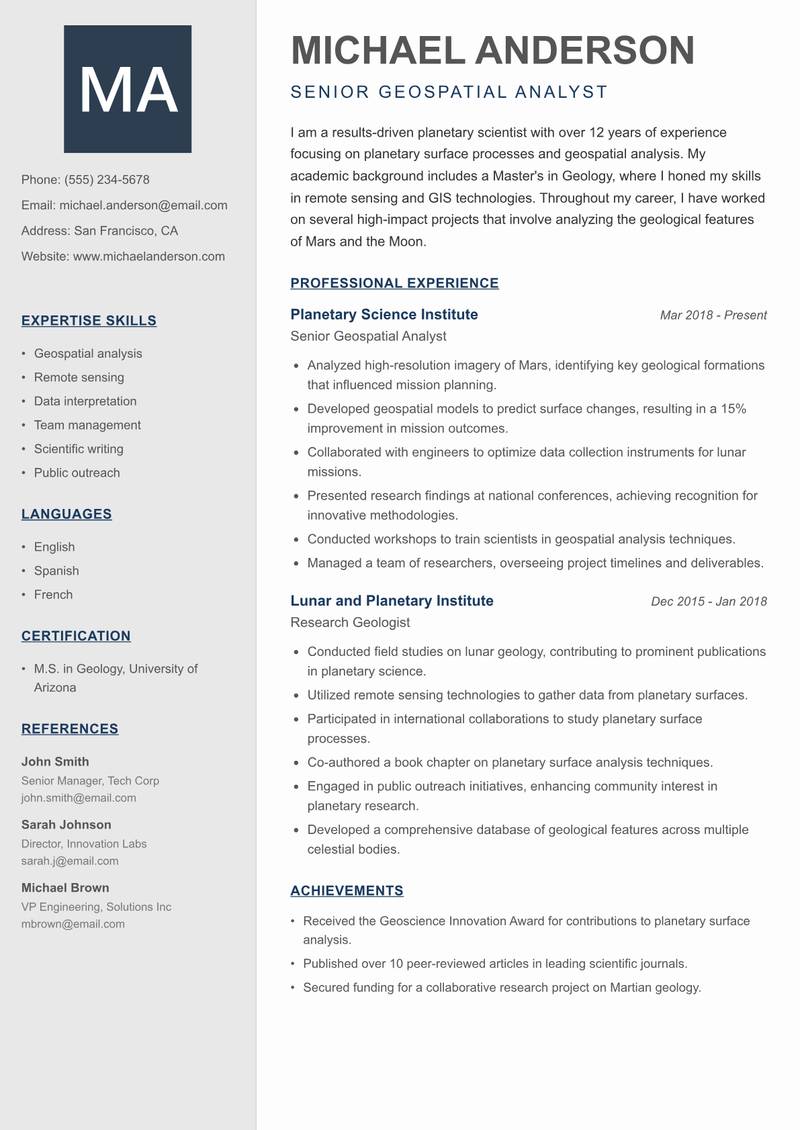
Senior Geospatial Analyst Resume

I am a results-driven planetary scientist with over 12 years of experience focusing on planetary surface processes and geospatial analysis. My academic background includes a Master's in Geology, where I honed my skills in remote sensing and GIS technologies. Throughout my career, I have worked on several high-impact projects that involve analyzing the geological features of Mars and the Moon. My analytical mindset allows me to derive meaningful conclusions from complex datasets, which has led to significant advancements in our understanding of planetary formations. I am an advocate for science communication and have worked to promote public interest in space exploration through various outreach initiatives. My goal is to contribute to cutting-edge research while inspiring the next generation of scientists through education and engagement.

Geospatial analysis Remote sensing Data interpretation Team management Scientific writing Public outreach
  1. Analyzed high-resolution imagery of Mars, identifying key geological formations that influenced mission planning.
  2. Developed geospatial models to predict surface changes, resulting in a 15% improvement in mission outcomes.
  3. Collaborated with engineers to optimize data collection instruments for lunar missions.
  4. Presented research findings at national conferences, achieving recognition for innovative methodologies.
  5. Conducted workshops to train scientists in geospatial analysis techniques.
  6. Managed a team of researchers, overseeing project timelines and deliverables.
  1. Conducted field studies on lunar geology, contributing to prominent publications in planetary science.
  2. Utilized remote sensing technologies to gather data from planetary surfaces.
  3. Participated in international collaborations to study planetary surface processes.
  4. Co-authored a book chapter on planetary surface analysis techniques.
  5. Engaged in public outreach initiatives, enhancing community interest in planetary research.
  6. Developed a comprehensive database of geological features across multiple celestial bodies.

Achievements

  • Received the Geoscience Innovation Award for contributions to planetary surface analysis.
  • Published over 10 peer-reviewed articles in leading scientific journals.
  • Secured funding for a collaborative research project on Martian geology.
⏱️
Experience
2-5 Years
📅
Level
Mid Level
🎓
Education
M.S. in Geology, University of...

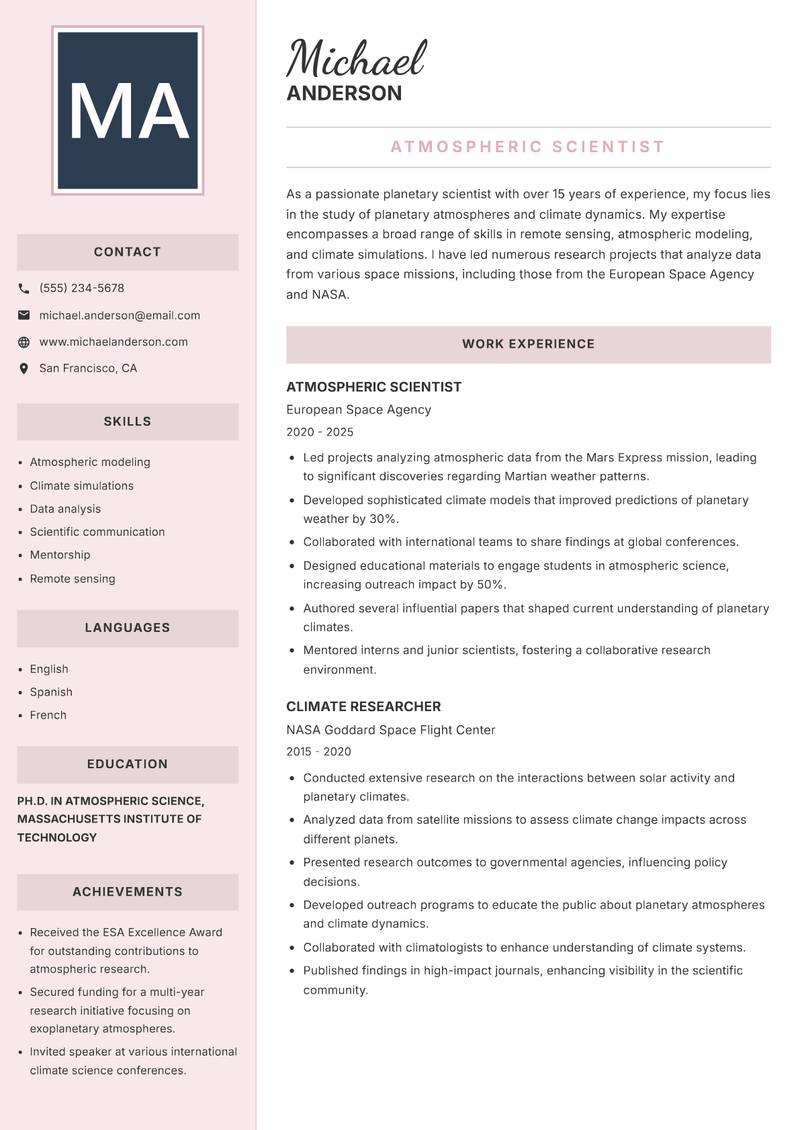
Atmospheric Scientist Resume

As a passionate planetary scientist with over 15 years of experience, my focus lies in the study of planetary atmospheres and climate dynamics. My expertise encompasses a broad range of skills in remote sensing, atmospheric modeling, and climate simulations. I have led numerous research projects that analyze data from various space missions, including those from the European Space Agency and NASA. My commitment to scientific excellence has been recognized through multiple awards, and I actively participate in mentoring young scientists in the field. I believe in the importance of interdisciplinary collaboration to foster innovation and am driven to uncover the secrets of our solar system's atmospheres. My goal is to contribute to groundbreaking research that enhances our understanding of climate change both on Earth and beyond.

Atmospheric modeling Climate simulations Data analysis Scientific communication Mentorship Remote sensing
  1. Led projects analyzing atmospheric data from the Mars Express mission, leading to significant discoveries regarding Martian weather patterns.
  2. Developed sophisticated climate models that improved predictions of planetary weather by 30%.
  3. Collaborated with international teams to share findings at global conferences.
  4. Designed educational materials to engage students in atmospheric science, increasing outreach impact by 50%.
  5. Authored several influential papers that shaped current understanding of planetary climates.
  6. Mentored interns and junior scientists, fostering a collaborative research environment.
  1. Conducted extensive research on the interactions between solar activity and planetary climates.
  2. Analyzed data from satellite missions to assess climate change impacts across different planets.
  3. Presented research outcomes to governmental agencies, influencing policy decisions.
  4. Developed outreach programs to educate the public about planetary atmospheres and climate dynamics.
  5. Collaborated with climatologists to enhance understanding of climate systems.
  6. Published findings in high-impact journals, enhancing visibility in the scientific community.

Achievements

  • Received the ESA Excellence Award for outstanding contributions to atmospheric research.
  • Secured funding for a multi-year research initiative focusing on exoplanetary atmospheres.
  • Invited speaker at various international climate science conferences.
⏱️
Experience
2-5 Years
📅
Level
Mid Level
🎓
Education
Ph.D. in Atmospheric Science, ...

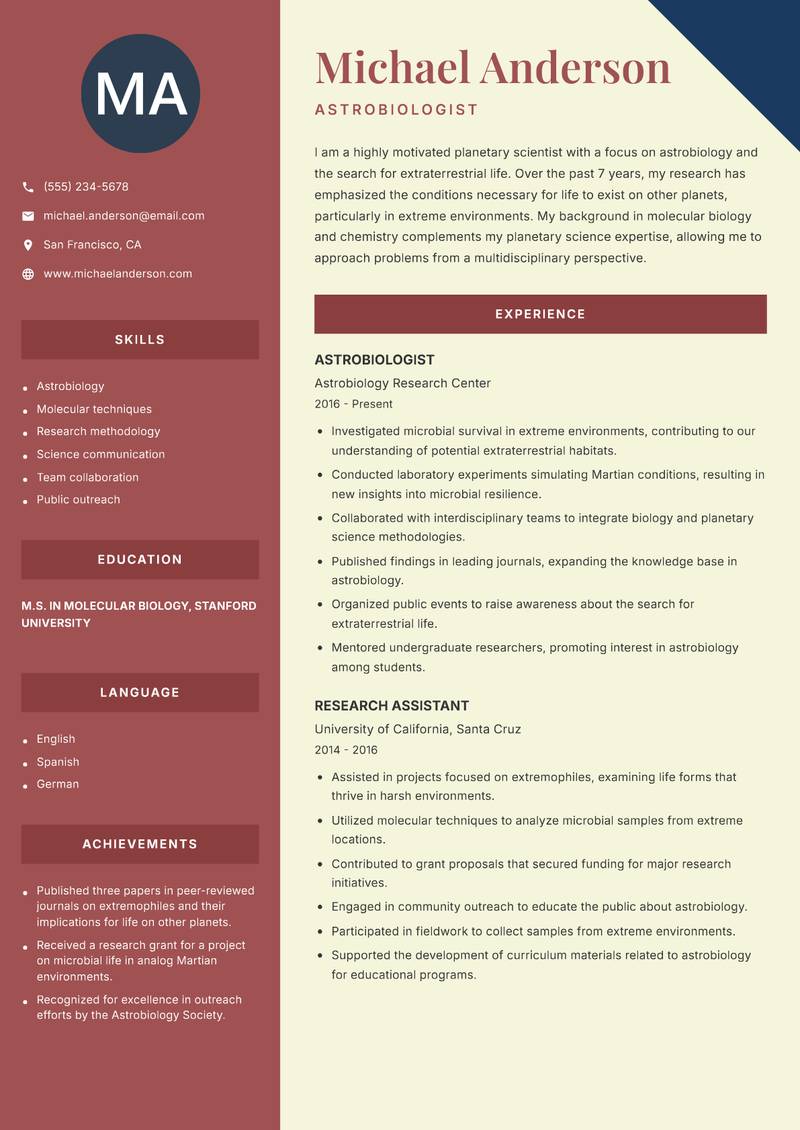
Astrobiologist Resume

I am a highly motivated planetary scientist with a focus on astrobiology and the search for extraterrestrial life. Over the past 7 years, my research has emphasized the conditions necessary for life to exist on other planets, particularly in extreme environments. My background in molecular biology and chemistry complements my planetary science expertise, allowing me to approach problems from a multidisciplinary perspective. I have been involved in several key research projects, including the analysis of microbial life in analog environments on Earth. My work has been published in notable journals, and I actively engage in science communication to promote public interest in astrobiology. I am eager to continue exploring the boundaries of life in the universe and to contribute to future missions that seek to answer fundamental questions about our existence.

Astrobiology Molecular techniques Research methodology Science communication Team collaboration Public outreach
  1. Investigated microbial survival in extreme environments, contributing to our understanding of potential extraterrestrial habitats.
  2. Conducted laboratory experiments simulating Martian conditions, resulting in new insights into microbial resilience.
  3. Collaborated with interdisciplinary teams to integrate biology and planetary science methodologies.
  4. Published findings in leading journals, expanding the knowledge base in astrobiology.
  5. Organized public events to raise awareness about the search for extraterrestrial life.
  6. Mentored undergraduate researchers, promoting interest in astrobiology among students.
  1. Assisted in projects focused on extremophiles, examining life forms that thrive in harsh environments.
  2. Utilized molecular techniques to analyze microbial samples from extreme locations.
  3. Contributed to grant proposals that secured funding for major research initiatives.
  4. Engaged in community outreach to educate the public about astrobiology.
  5. Participated in fieldwork to collect samples from extreme environments.
  6. Supported the development of curriculum materials related to astrobiology for educational programs.

Achievements

  • Published three papers in peer-reviewed journals on extremophiles and their implications for life on other planets.
  • Received a research grant for a project on microbial life in analog Martian environments.
  • Recognized for excellence in outreach efforts by the Astrobiology Society.
⏱️
Experience
2-5 Years
📅
Level
Mid Level
🎓
Education
M.S. in Molecular Biology, Sta...

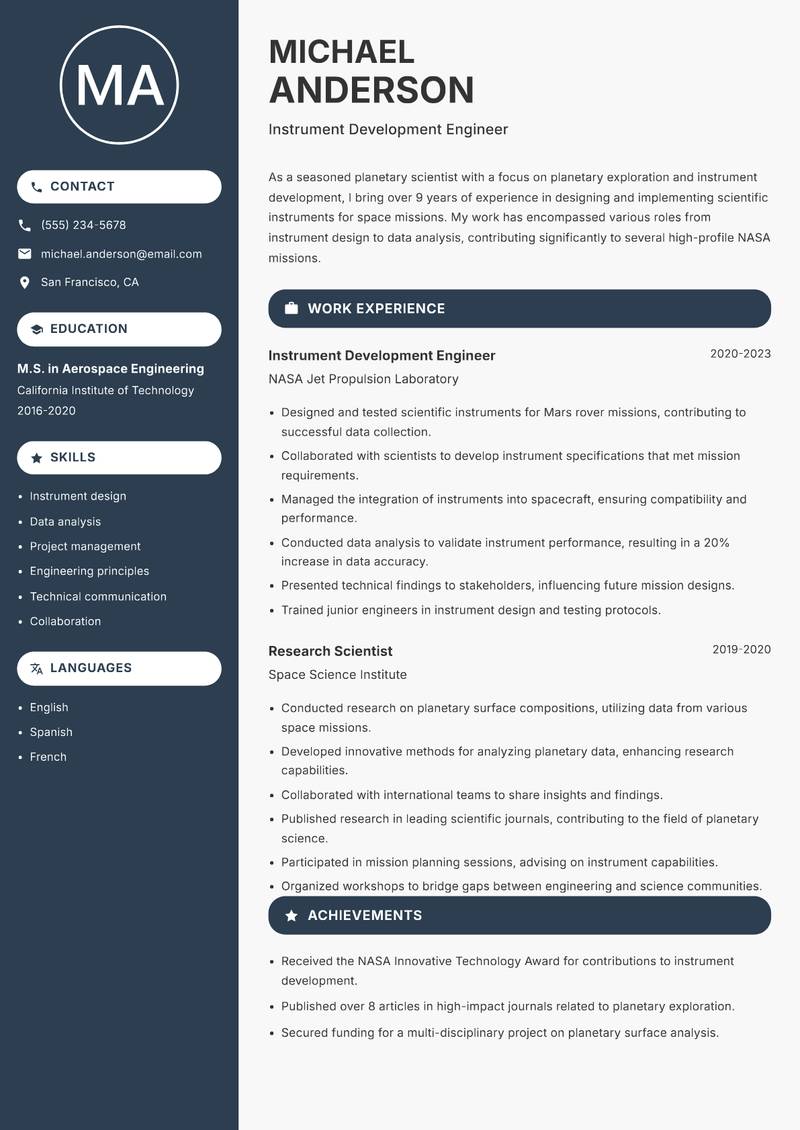
Instrument Development Engineer Resume

As a seasoned planetary scientist with a focus on planetary exploration and instrument development, I bring over 9 years of experience in designing and implementing scientific instruments for space missions. My work has encompassed various roles from instrument design to data analysis, contributing significantly to several high-profile NASA missions. I possess a strong foundation in engineering principles, which I combine with my scientific expertise to develop innovative solutions for space exploration. I am passionate about advancing technology that enhances our understanding of planetary bodies and their atmospheres. My goal is to lead projects that push the boundaries of current scientific capabilities and to contribute to the next generation of space exploration missions.

Instrument design Data analysis Project management Engineering principles Technical communication Collaboration
  1. Designed and tested scientific instruments for Mars rover missions, contributing to successful data collection.
  2. Collaborated with scientists to develop instrument specifications that met mission requirements.
  3. Managed the integration of instruments into spacecraft, ensuring compatibility and performance.
  4. Conducted data analysis to validate instrument performance, resulting in a 20% increase in data accuracy.
  5. Presented technical findings to stakeholders, influencing future mission designs.
  6. Trained junior engineers in instrument design and testing protocols.
  1. Conducted research on planetary surface compositions, utilizing data from various space missions.
  2. Developed innovative methods for analyzing planetary data, enhancing research capabilities.
  3. Collaborated with international teams to share insights and findings.
  4. Published research in leading scientific journals, contributing to the field of planetary science.
  5. Participated in mission planning sessions, advising on instrument capabilities.
  6. Organized workshops to bridge gaps between engineering and science communities.

Achievements

  • Received the NASA Innovative Technology Award for contributions to instrument development.
  • Published over 8 articles in high-impact journals related to planetary exploration.
  • Secured funding for a multi-disciplinary project on planetary surface analysis.
⏱️
Experience
2-5 Years
📅
Level
Mid Level
🎓
Education
M.S. in Aerospace Engineering,...

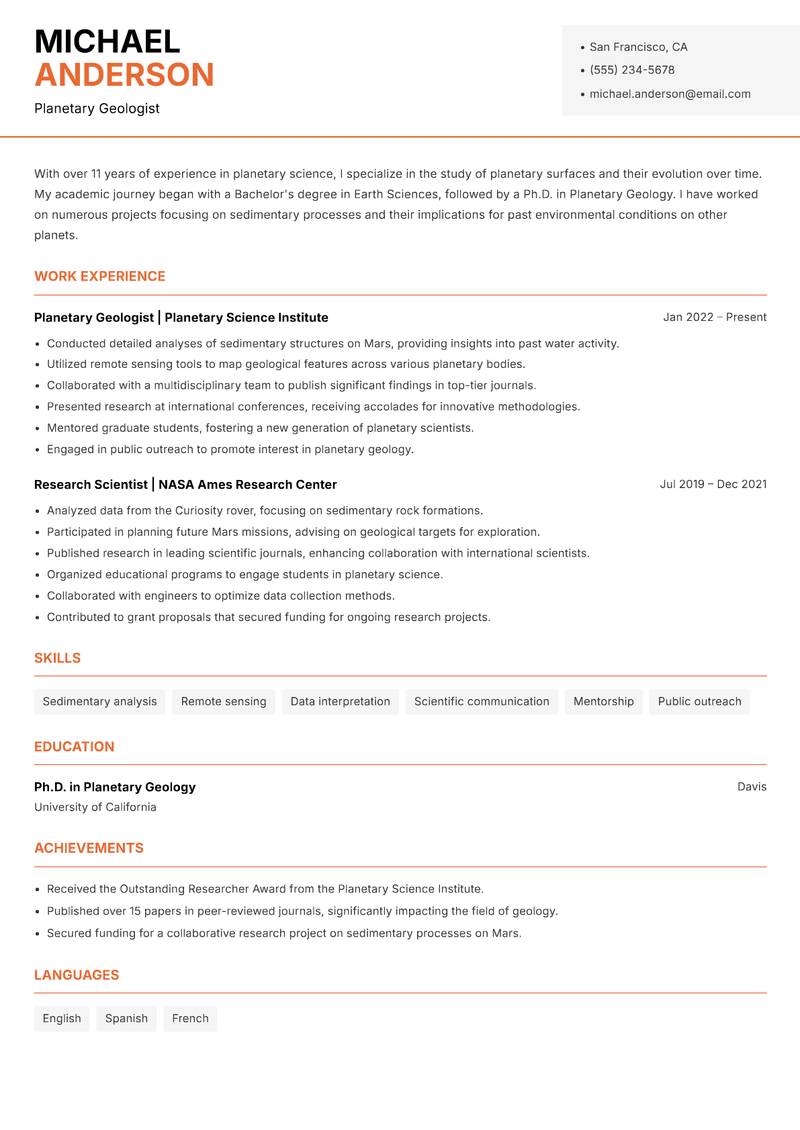
Planetary Geologist Resume

With over 11 years of experience in planetary science, I specialize in the study of planetary surfaces and their evolution over time. My academic journey began with a Bachelor's degree in Earth Sciences, followed by a Ph.D. in Planetary Geology. I have worked on numerous projects focusing on sedimentary processes and their implications for past environmental conditions on other planets. My research has been recognized with several awards, and I am committed to promoting diversity within the scientific community. I believe that a diverse range of perspectives enhances the quality of research and fosters innovation. My goal is to continue exploring planetary surfaces and contributing to our understanding of their history and evolution.

Sedimentary analysis Remote sensing Data interpretation Scientific communication Mentorship Public outreach
  1. Conducted detailed analyses of sedimentary structures on Mars, providing insights into past water activity.
  2. Utilized remote sensing tools to map geological features across various planetary bodies.
  3. Collaborated with a multidisciplinary team to publish significant findings in top-tier journals.
  4. Presented research at international conferences, receiving accolades for innovative methodologies.
  5. Mentored graduate students, fostering a new generation of planetary scientists.
  6. Engaged in public outreach to promote interest in planetary geology.
  1. Analyzed data from the Curiosity rover, focusing on sedimentary rock formations.
  2. Participated in planning future Mars missions, advising on geological targets for exploration.
  3. Published research in leading scientific journals, enhancing collaboration with international scientists.
  4. Organized educational programs to engage students in planetary science.
  5. Collaborated with engineers to optimize data collection methods.
  6. Contributed to grant proposals that secured funding for ongoing research projects.

Achievements

  • Received the Outstanding Researcher Award from the Planetary Science Institute.
  • Published over 15 papers in peer-reviewed journals, significantly impacting the field of geology.
  • Secured funding for a collaborative research project on sedimentary processes on Mars.
⏱️
Experience
2-5 Years
📅
Level
Mid Level
🎓
Education
Ph.D. in Planetary Geology, Un...

Key Skills for Planetary Scientist Positions

Successful planetary scientist professionals typically possess a combination of technical expertise, soft skills, and industry knowledge. Common skills include problem-solving abilities, attention to detail, communication skills, and proficiency in relevant tools and technologies specific to the role.

Typical Responsibilities

Planetary Scientist roles often involve a range of responsibilities that may include project management, collaboration with cross-functional teams, meeting deadlines, maintaining quality standards, and contributing to organizational goals. Specific duties vary by company and seniority level.

Resume Tips for Planetary Scientist Applications

ATS Optimization

Applicant Tracking Systems (ATS) scan resumes for keywords and formatting. To optimize your planetary scientist resume for ATS:

Frequently Asked Questions

How do I customize this planetary scientist resume template?

You can customize this resume template by replacing the placeholder content with your own information. Update the professional summary, work experience, education, and skills sections to match your background. Ensure all dates, company names, and achievements are accurate and relevant to your career history.

Is this planetary scientist resume template ATS-friendly?

Yes, this resume template is designed to be ATS-friendly. It uses standard section headings, clear formatting, and avoids complex graphics or tables that can confuse applicant tracking systems. The structure follows best practices for ATS compatibility, making it easier for your resume to be parsed correctly by automated systems.

What is the ideal length for a planetary scientist resume?

For most planetary scientist positions, a one to two-page resume is ideal. Entry-level candidates should aim for one page, while experienced professionals with extensive work history may use two pages. Focus on the most relevant and recent experience, and ensure every section adds value to your application.

How should I format my planetary scientist resume for best results?

Use a clean, professional format with consistent fonts and spacing. Include standard sections such as Contact Information, Professional Summary, Work Experience, Education, and Skills. Use bullet points for easy scanning, and ensure your contact information is clearly visible at the top. Save your resume as a PDF to preserve formatting across different devices and systems.

Can I use this template for different planetary scientist job applications?

Yes, you can use this template as a base for multiple applications. However, it's recommended to tailor your resume for each specific job posting. Review the job description carefully and incorporate relevant keywords, skills, and experiences that match the requirements. Customizing your resume for each application increases your chances of passing ATS filters and catching the attention of hiring managers.

Scroll to view samples