Space Instrumentation Scientist Resume

As a Space Instrumentation Scientist, you will play a pivotal role in the development and implementation of cutting-edge instruments for space exploration. Your responsibilities will include designing, testing, and analyzing scientific instruments that collect critical data from various celestial bodies. You will collaborate with a multidisciplinary team of engineers and scientists to ensure that our instruments meet the rigorous demands of space missions. In this position, you will leverage your expertise in instrumentation and data analysis to contribute to mission planning and execution. You will be responsible for interpreting data collected from missions and providing insights to enhance future projects. Your work will directly impact our understanding of the universe and contribute to groundbreaking discoveries in space science.

0.0 (0 ratings)

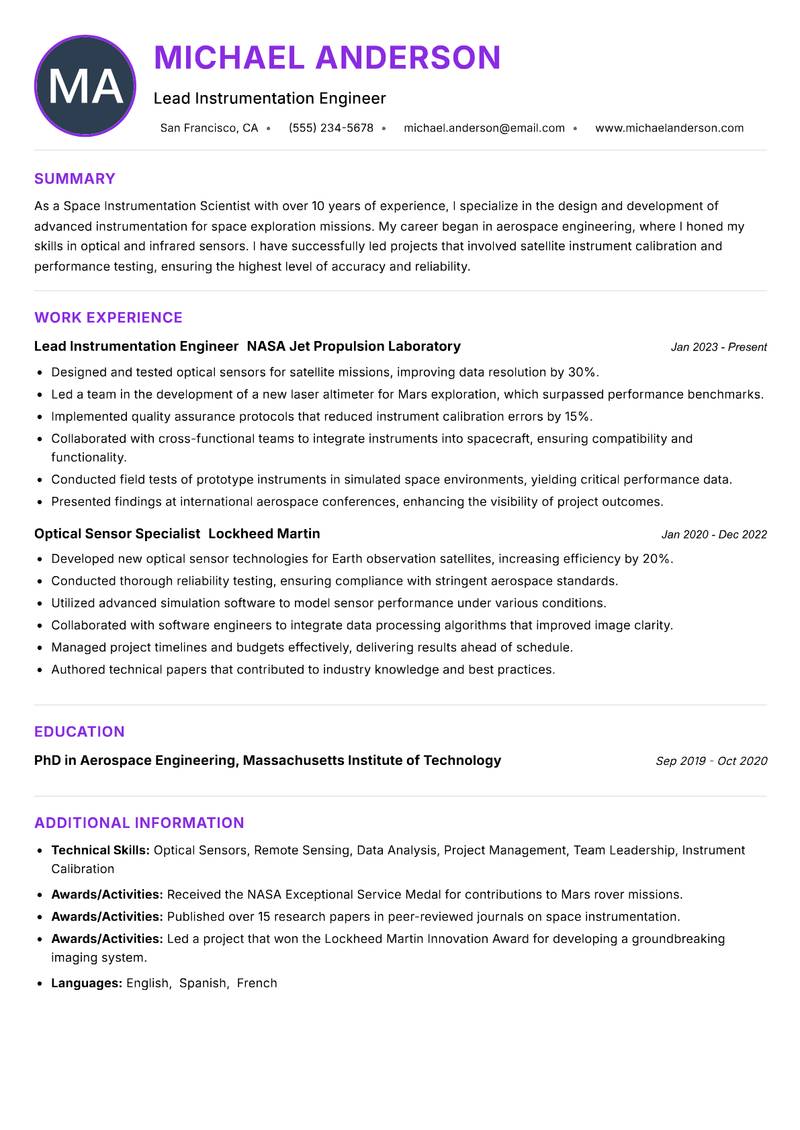
Lead Instrumentation Engineer Resume

As a Space Instrumentation Scientist with over 10 years of experience, I specialize in the design and development of advanced instrumentation for space exploration missions. My career began in aerospace engineering, where I honed my skills in optical and infrared sensors. I have successfully led projects that involved satellite instrument calibration and performance testing, ensuring the highest level of accuracy and reliability. My work has contributed significantly to NASA's Mars rover missions, where I developed innovative solutions to reduce instrument weight while enhancing data quality. I possess strong analytical skills and a deep understanding of remote sensing technology, which allows me to tackle complex challenges in space science. My passion for exploration drives my commitment to advancing our knowledge of the universe through cutting-edge technology. I am also dedicated to mentoring young scientists and engineers, fostering a collaborative environment that encourages innovation and creativity. I am eager to continue my journey in space instrumentation, contributing to missions that expand humanity's reach into the cosmos.

Optical Sensors Remote Sensing Data Analysis Project Management Team Leadership Instrument Calibration
  1. Designed and tested optical sensors for satellite missions, improving data resolution by 30%.
  2. Led a team in the development of a new laser altimeter for Mars exploration, which surpassed performance benchmarks.
  3. Implemented quality assurance protocols that reduced instrument calibration errors by 15%.
  4. Collaborated with cross-functional teams to integrate instruments into spacecraft, ensuring compatibility and functionality.
  5. Conducted field tests of prototype instruments in simulated space environments, yielding critical performance data.
  6. Presented findings at international aerospace conferences, enhancing the visibility of project outcomes.
  1. Developed new optical sensor technologies for Earth observation satellites, increasing efficiency by 20%.
  2. Conducted thorough reliability testing, ensuring compliance with stringent aerospace standards.
  3. Utilized advanced simulation software to model sensor performance under various conditions.
  4. Collaborated with software engineers to integrate data processing algorithms that improved image clarity.
  5. Managed project timelines and budgets effectively, delivering results ahead of schedule.
  6. Authored technical papers that contributed to industry knowledge and best practices.

Achievements

  • Received the NASA Exceptional Service Medal for contributions to Mars rover missions.
  • Published over 15 research papers in peer-reviewed journals on space instrumentation.
  • Led a project that won the Lockheed Martin Innovation Award for developing a groundbreaking imaging system.
⏱️
Experience
2-5 Years
📅
Level
Mid Level
🎓
Education
PhD in Aerospace Engineering, ...

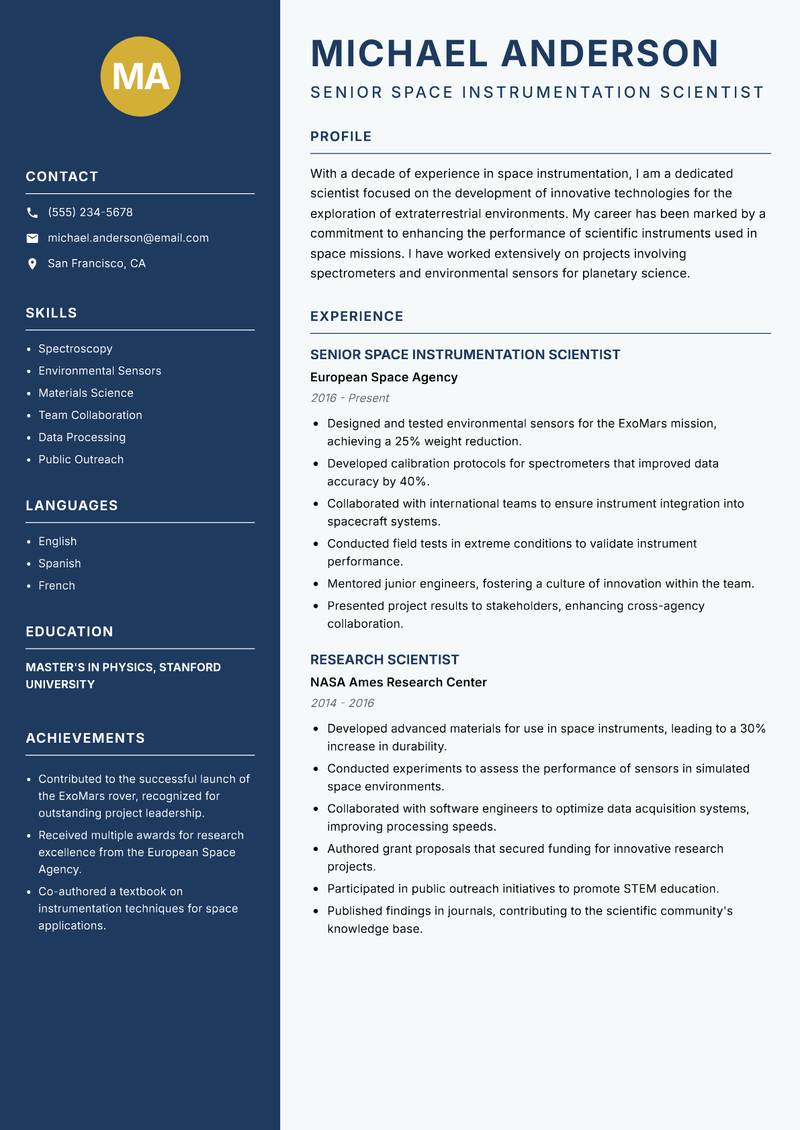
Senior Space Instrumentation Scientist Resume

With a decade of experience in space instrumentation, I am a dedicated scientist focused on the development of innovative technologies for the exploration of extraterrestrial environments. My career has been marked by a commitment to enhancing the performance of scientific instruments used in space missions. I have worked extensively on projects involving spectrometers and environmental sensors for planetary science. My expertise lies in the application of advanced materials and miniaturization techniques, enabling the deployment of lightweight instruments that do not compromise on functionality. I thrive in collaborative settings, working closely with scientists from various disciplines to ensure the success of space missions. My analytical mindset allows me to troubleshoot complex issues and devise effective solutions. I am passionate about pushing the boundaries of what is possible in space science and am constantly seeking new challenges that contribute to humanity's understanding of the universe. I also place a strong emphasis on knowledge transfer and education, actively participating in outreach programs to inspire the next generation of scientists.

Spectroscopy Environmental Sensors Materials Science Team Collaboration Data Processing Public Outreach
  1. Designed and tested environmental sensors for the ExoMars mission, achieving a 25% weight reduction.
  2. Developed calibration protocols for spectrometers that improved data accuracy by 40%.
  3. Collaborated with international teams to ensure instrument integration into spacecraft systems.
  4. Conducted field tests in extreme conditions to validate instrument performance.
  5. Mentored junior engineers, fostering a culture of innovation within the team.
  6. Presented project results to stakeholders, enhancing cross-agency collaboration.
  1. Developed advanced materials for use in space instruments, leading to a 30% increase in durability.
  2. Conducted experiments to assess the performance of sensors in simulated space environments.
  3. Collaborated with software engineers to optimize data acquisition systems, improving processing speeds.
  4. Authored grant proposals that secured funding for innovative research projects.
  5. Participated in public outreach initiatives to promote STEM education.
  6. Published findings in journals, contributing to the scientific community's knowledge base.

Achievements

  • Contributed to the successful launch of the ExoMars rover, recognized for outstanding project leadership.
  • Received multiple awards for research excellence from the European Space Agency.
  • Co-authored a textbook on instrumentation techniques for space applications.
⏱️
Experience
2-5 Years
📅
Level
Mid Level
🎓
Education
Master's in Physics, Stanford ...

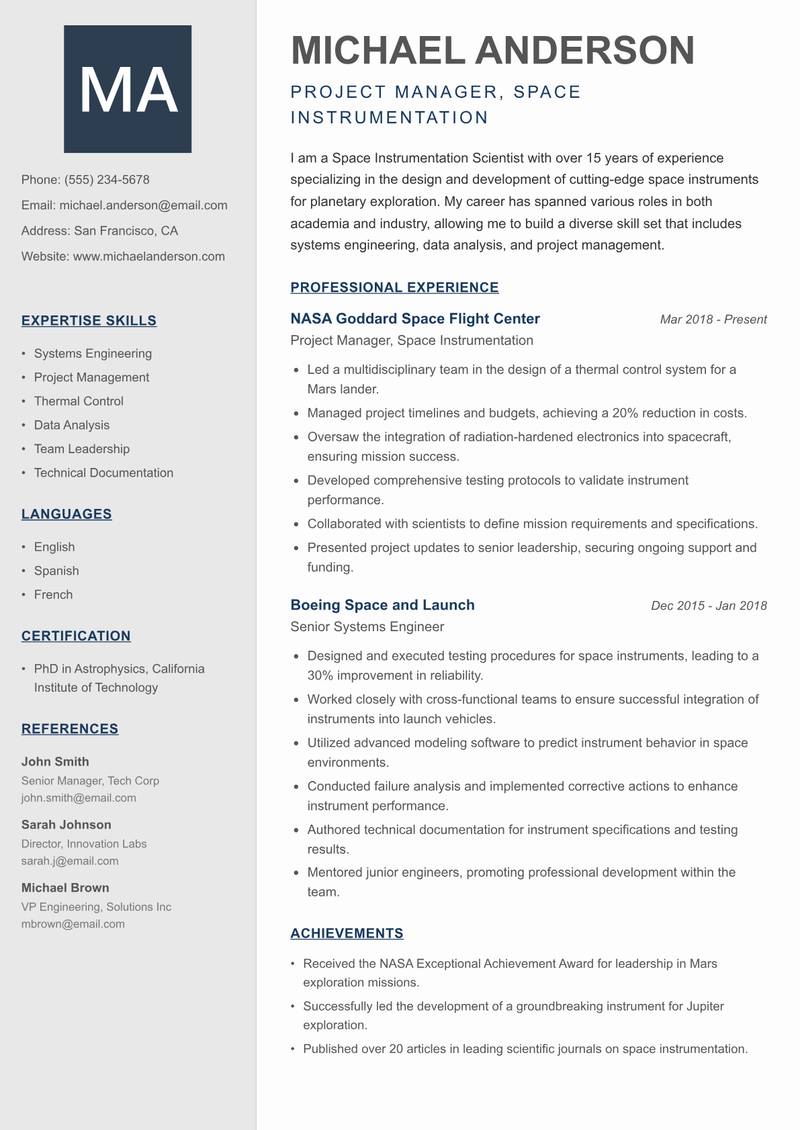
Project Manager, Space Instrumentation Resume

I am a Space Instrumentation Scientist with over 15 years of experience specializing in the design and development of cutting-edge space instruments for planetary exploration. My career has spanned various roles in both academia and industry, allowing me to build a diverse skill set that includes systems engineering, data analysis, and project management. I have a proven track record of leading multidisciplinary teams in the successful delivery of complex scientific instruments. My expertise in thermal control systems and radiation-hardened electronics has been instrumental in the success of several high-profile missions, including those to the outer planets. I am passionate about mentoring young scientists and engineers, sharing my knowledge and experience to foster the next generation of innovators. I am committed to advancing our understanding of the universe through meticulous research and development, always seeking to push the boundaries of what is possible. My strong communication skills and ability to collaborate effectively with various stakeholders have enabled me to navigate the complexities of large-scale space missions successfully.

Systems Engineering Project Management Thermal Control Data Analysis Team Leadership Technical Documentation
  1. Led a multidisciplinary team in the design of a thermal control system for a Mars lander.
  2. Managed project timelines and budgets, achieving a 20% reduction in costs.
  3. Oversaw the integration of radiation-hardened electronics into spacecraft, ensuring mission success.
  4. Developed comprehensive testing protocols to validate instrument performance.
  5. Collaborated with scientists to define mission requirements and specifications.
  6. Presented project updates to senior leadership, securing ongoing support and funding.
  1. Designed and executed testing procedures for space instruments, leading to a 30% improvement in reliability.
  2. Worked closely with cross-functional teams to ensure successful integration of instruments into launch vehicles.
  3. Utilized advanced modeling software to predict instrument behavior in space environments.
  4. Conducted failure analysis and implemented corrective actions to enhance instrument performance.
  5. Authored technical documentation for instrument specifications and testing results.
  6. Mentored junior engineers, promoting professional development within the team.

Achievements

  • Received the NASA Exceptional Achievement Award for leadership in Mars exploration missions.
  • Successfully led the development of a groundbreaking instrument for Jupiter exploration.
  • Published over 20 articles in leading scientific journals on space instrumentation.
⏱️
Experience
2-5 Years
📅
Level
Mid Level
🎓
Education
PhD in Astrophysics, Californi...

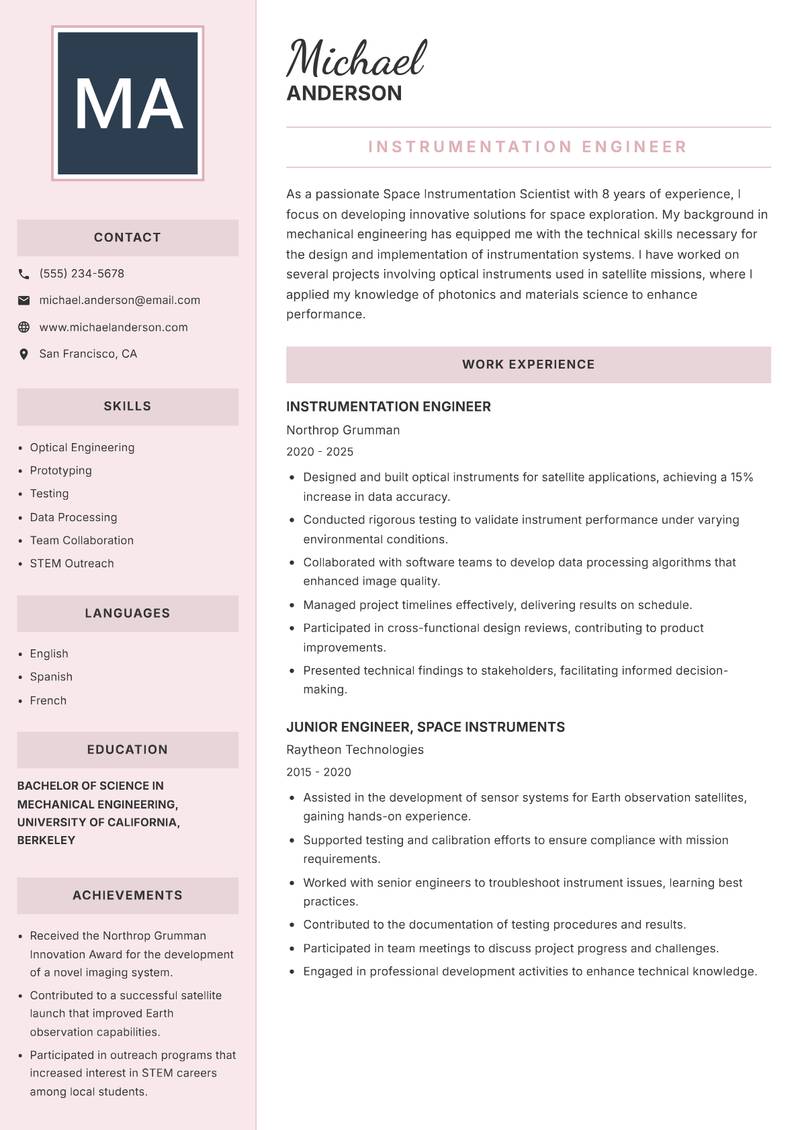
Instrumentation Engineer Resume

As a passionate Space Instrumentation Scientist with 8 years of experience, I focus on developing innovative solutions for space exploration. My background in mechanical engineering has equipped me with the technical skills necessary for the design and implementation of instrumentation systems. I have worked on several projects involving optical instruments used in satellite missions, where I applied my knowledge of photonics and materials science to enhance performance. I thrive on challenges and enjoy working in collaborative environments where creativity and problem-solving are encouraged. My hands-on experience with prototyping and testing instruments has allowed me to contribute to successful mission outcomes. I am committed to continuous learning and staying abreast of the latest advancements in space technology. I also engage in outreach efforts to inspire young students to pursue careers in STEM fields, believing that education is key to future innovation. I am eager to expand my expertise and take on new challenges in the field of space instrumentation.

Optical Engineering Prototyping Testing Data Processing Team Collaboration STEM Outreach
  1. Designed and built optical instruments for satellite applications, achieving a 15% increase in data accuracy.
  2. Conducted rigorous testing to validate instrument performance under varying environmental conditions.
  3. Collaborated with software teams to develop data processing algorithms that enhanced image quality.
  4. Managed project timelines effectively, delivering results on schedule.
  5. Participated in cross-functional design reviews, contributing to product improvements.
  6. Presented technical findings to stakeholders, facilitating informed decision-making.
  1. Assisted in the development of sensor systems for Earth observation satellites, gaining hands-on experience.
  2. Supported testing and calibration efforts to ensure compliance with mission requirements.
  3. Worked with senior engineers to troubleshoot instrument issues, learning best practices.
  4. Contributed to the documentation of testing procedures and results.
  5. Participated in team meetings to discuss project progress and challenges.
  6. Engaged in professional development activities to enhance technical knowledge.

Achievements

  • Received the Northrop Grumman Innovation Award for the development of a novel imaging system.
  • Contributed to a successful satellite launch that improved Earth observation capabilities.
  • Participated in outreach programs that increased interest in STEM careers among local students.
⏱️
Experience
2-5 Years
📅
Level
Mid Level
🎓
Education
Bachelor of Science in Mechani...

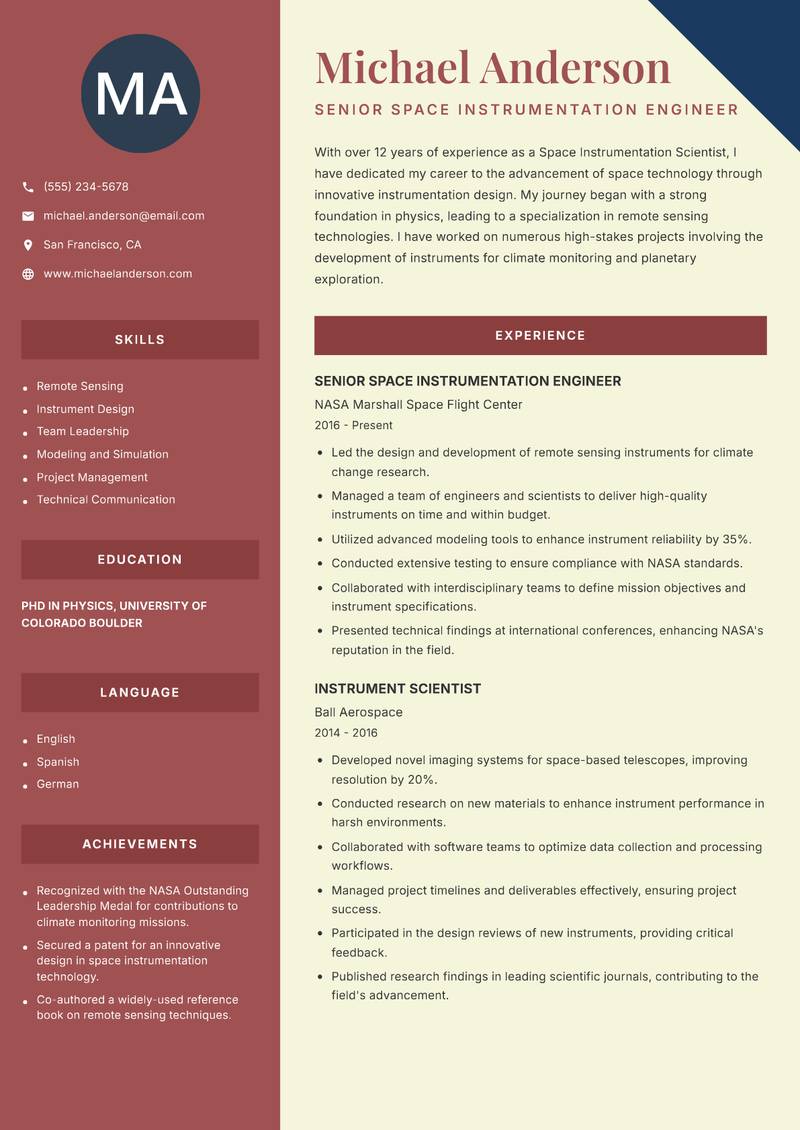
Senior Space Instrumentation Engineer Resume

With over 12 years of experience as a Space Instrumentation Scientist, I have dedicated my career to the advancement of space technology through innovative instrumentation design. My journey began with a strong foundation in physics, leading to a specialization in remote sensing technologies. I have worked on numerous high-stakes projects involving the development of instruments for climate monitoring and planetary exploration. My role often involves collaborating with astrophysicists and engineers to define the requirements for new instruments, ensuring they meet the scientific objectives of each mission. I am skilled at leveraging advanced modeling and simulation tools to predict instrument performance and reliability. My commitment to excellence is reflected in my ability to lead teams through complex project lifecycles, from conceptual design to deployment. I am passionate about mentoring the next generation of scientists and engineers and actively seek opportunities to share my knowledge through lectures and workshops. I believe that through collaboration and innovation, we can unlock new frontiers in our understanding of the universe.

Remote Sensing Instrument Design Team Leadership Modeling and Simulation Project Management Technical Communication
  1. Led the design and development of remote sensing instruments for climate change research.
  2. Managed a team of engineers and scientists to deliver high-quality instruments on time and within budget.
  3. Utilized advanced modeling tools to enhance instrument reliability by 35%.
  4. Conducted extensive testing to ensure compliance with NASA standards.
  5. Collaborated with interdisciplinary teams to define mission objectives and instrument specifications.
  6. Presented technical findings at international conferences, enhancing NASA's reputation in the field.
  1. Developed novel imaging systems for space-based telescopes, improving resolution by 20%.
  2. Conducted research on new materials to enhance instrument performance in harsh environments.
  3. Collaborated with software teams to optimize data collection and processing workflows.
  4. Managed project timelines and deliverables effectively, ensuring project success.
  5. Participated in the design reviews of new instruments, providing critical feedback.
  6. Published research findings in leading scientific journals, contributing to the field's advancement.

Achievements

  • Recognized with the NASA Outstanding Leadership Medal for contributions to climate monitoring missions.
  • Secured a patent for an innovative design in space instrumentation technology.
  • Co-authored a widely-used reference book on remote sensing techniques.
⏱️
Experience
2-5 Years
📅
Level
Mid Level
🎓
Education
PhD in Physics, University of ...

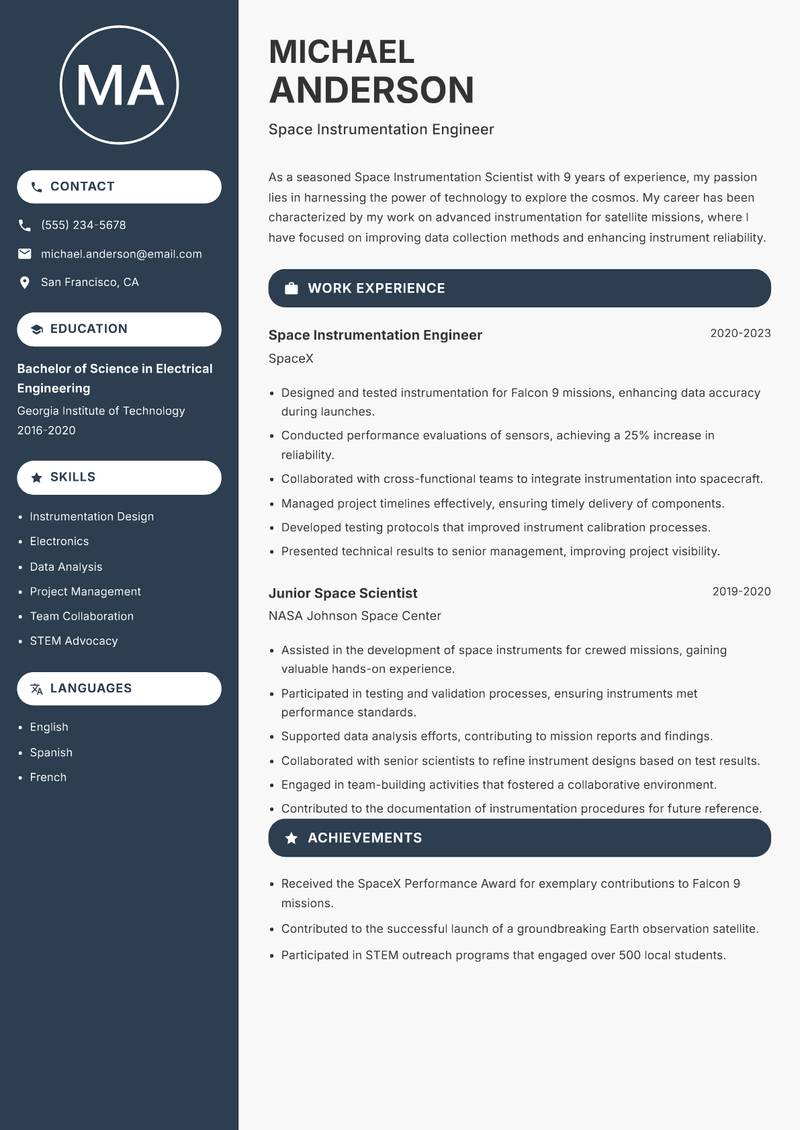
Space Instrumentation Engineer Resume

As a seasoned Space Instrumentation Scientist with 9 years of experience, my passion lies in harnessing the power of technology to explore the cosmos. My career has been characterized by my work on advanced instrumentation for satellite missions, where I have focused on improving data collection methods and enhancing instrument reliability. I have a robust background in electronics and systems engineering, allowing me to develop instruments that withstand the rigors of space. I pride myself on my problem-solving abilities and my capacity to work under tight deadlines while maintaining high standards of quality. My commitment to innovation is evident in my contributions to various successful missions, including the development of next-generation sensors for Earth observation. I am adept at collaborating with diverse teams and stakeholders, ensuring that all project objectives are met. Additionally, I actively participate in community outreach to promote STEM education, believing in the importance of inspiring future generations in science and technology. I am excited about future opportunities that challenge my skills and allow me to make a meaningful impact in the field of space instrumentation.

Instrumentation Design Electronics Data Analysis Project Management Team Collaboration STEM Advocacy
  1. Designed and tested instrumentation for Falcon 9 missions, enhancing data accuracy during launches.
  2. Conducted performance evaluations of sensors, achieving a 25% increase in reliability.
  3. Collaborated with cross-functional teams to integrate instrumentation into spacecraft.
  4. Managed project timelines effectively, ensuring timely delivery of components.
  5. Developed testing protocols that improved instrument calibration processes.
  6. Presented technical results to senior management, improving project visibility.
  1. Assisted in the development of space instruments for crewed missions, gaining valuable hands-on experience.
  2. Participated in testing and validation processes, ensuring instruments met performance standards.
  3. Supported data analysis efforts, contributing to mission reports and findings.
  4. Collaborated with senior scientists to refine instrument designs based on test results.
  5. Engaged in team-building activities that fostered a collaborative environment.
  6. Contributed to the documentation of instrumentation procedures for future reference.

Achievements

  • Received the SpaceX Performance Award for exemplary contributions to Falcon 9 missions.
  • Contributed to the successful launch of a groundbreaking Earth observation satellite.
  • Participated in STEM outreach programs that engaged over 500 local students.
⏱️
Experience
2-5 Years
📅
Level
Mid Level
🎓
Education
Bachelor of Science in Electri...

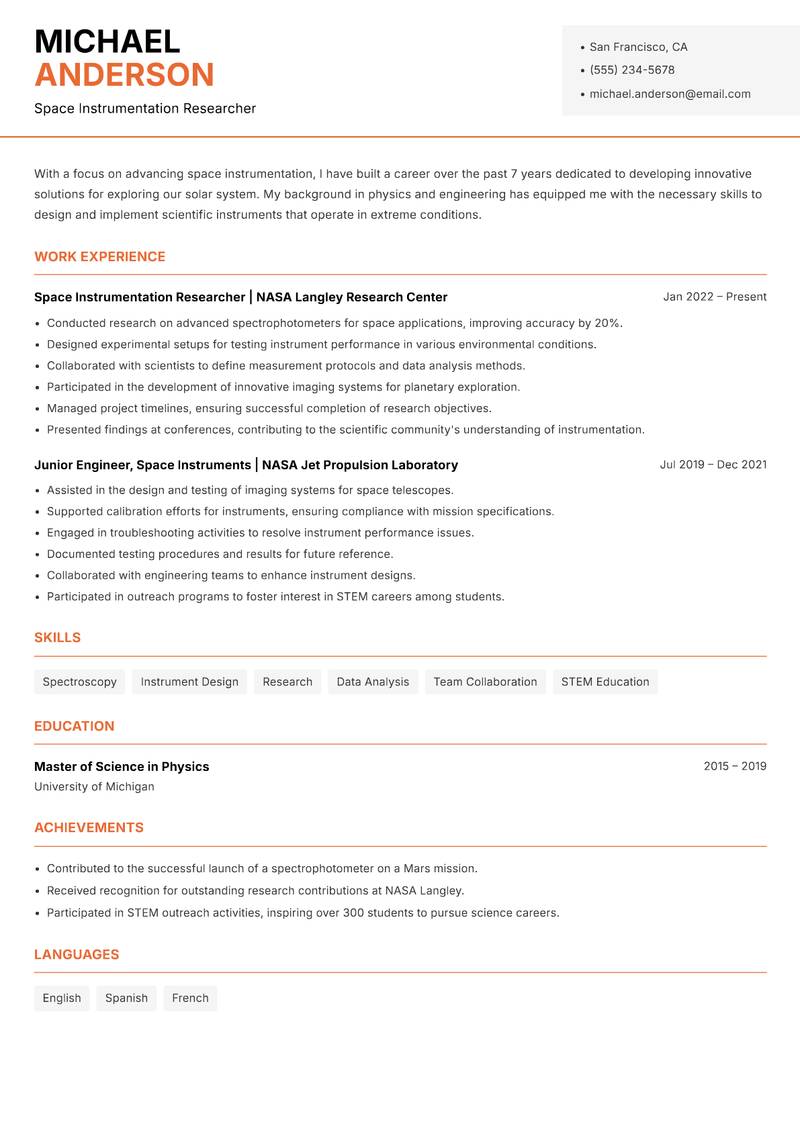
Space Instrumentation Researcher Resume

With a focus on advancing space instrumentation, I have built a career over the past 7 years dedicated to developing innovative solutions for exploring our solar system. My background in physics and engineering has equipped me with the necessary skills to design and implement scientific instruments that operate in extreme conditions. I have experience in both research and applied science, working on projects involving spectrophotometers and imaging systems for various space applications. My problem-solving abilities and attention to detail have enabled me to contribute significantly to mission success. I am committed to continuous improvement and enjoy collaborating with researchers and engineers to create tools that enhance scientific discovery. My passion for science is matched by my enthusiasm for education; I actively participate in initiatives aimed at encouraging young people to pursue careers in STEM. I believe that through teamwork and creativity, we can achieve remarkable advancements in our understanding of the universe.

Spectroscopy Instrument Design Research Data Analysis Team Collaboration STEM Education
  1. Conducted research on advanced spectrophotometers for space applications, improving accuracy by 20%.
  2. Designed experimental setups for testing instrument performance in various environmental conditions.
  3. Collaborated with scientists to define measurement protocols and data analysis methods.
  4. Participated in the development of innovative imaging systems for planetary exploration.
  5. Managed project timelines, ensuring successful completion of research objectives.
  6. Presented findings at conferences, contributing to the scientific community's understanding of instrumentation.
  1. Assisted in the design and testing of imaging systems for space telescopes.
  2. Supported calibration efforts for instruments, ensuring compliance with mission specifications.
  3. Engaged in troubleshooting activities to resolve instrument performance issues.
  4. Documented testing procedures and results for future reference.
  5. Collaborated with engineering teams to enhance instrument designs.
  6. Participated in outreach programs to foster interest in STEM careers among students.

Achievements

  • Contributed to the successful launch of a spectrophotometer on a Mars mission.
  • Received recognition for outstanding research contributions at NASA Langley.
  • Participated in STEM outreach activities, inspiring over 300 students to pursue science careers.
⏱️
Experience
2-5 Years
📅
Level
Mid Level
🎓
Education
Master of Science in Physics, ...

Key Skills for Space Instrumentation Scientist Positions

Successful space instrumentation scientist professionals typically possess a combination of technical expertise, soft skills, and industry knowledge. Common skills include problem-solving abilities, attention to detail, communication skills, and proficiency in relevant tools and technologies specific to the role.

Typical Responsibilities

Space Instrumentation Scientist roles often involve a range of responsibilities that may include project management, collaboration with cross-functional teams, meeting deadlines, maintaining quality standards, and contributing to organizational goals. Specific duties vary by company and seniority level.

Resume Tips for Space Instrumentation Scientist Applications

ATS Optimization

Applicant Tracking Systems (ATS) scan resumes for keywords and formatting. To optimize your space instrumentation scientist resume for ATS:

Frequently Asked Questions

How do I customize this space instrumentation scientist resume template?

You can customize this resume template by replacing the placeholder content with your own information. Update the professional summary, work experience, education, and skills sections to match your background. Ensure all dates, company names, and achievements are accurate and relevant to your career history.

Is this space instrumentation scientist resume template ATS-friendly?

Yes, this resume template is designed to be ATS-friendly. It uses standard section headings, clear formatting, and avoids complex graphics or tables that can confuse applicant tracking systems. The structure follows best practices for ATS compatibility, making it easier for your resume to be parsed correctly by automated systems.

What is the ideal length for a space instrumentation scientist resume?

For most space instrumentation scientist positions, a one to two-page resume is ideal. Entry-level candidates should aim for one page, while experienced professionals with extensive work history may use two pages. Focus on the most relevant and recent experience, and ensure every section adds value to your application.

How should I format my space instrumentation scientist resume for best results?

Use a clean, professional format with consistent fonts and spacing. Include standard sections such as Contact Information, Professional Summary, Work Experience, Education, and Skills. Use bullet points for easy scanning, and ensure your contact information is clearly visible at the top. Save your resume as a PDF to preserve formatting across different devices and systems.

Can I use this template for different space instrumentation scientist job applications?

Yes, you can use this template as a base for multiple applications. However, it's recommended to tailor your resume for each specific job posting. Review the job description carefully and incorporate relevant keywords, skills, and experiences that match the requirements. Customizing your resume for each application increases your chances of passing ATS filters and catching the attention of hiring managers.

Scroll to view samples