Observational Astronomer Resume

Observational Astronomers play a critical role in advancing our understanding of the universe by collecting and analyzing data from various astronomical sources. Utilizing powerful telescopes and cutting-edge technology, they observe celestial objects such as stars, planets, galaxies, and nebulae. Their work involves not only capturing images and spectra but also interpreting complex data to draw meaningful conclusions about the nature and behavior of these entities. In addition to conducting observations, Observational Astronomers collaborate with other scientists and researchers to develop new methodologies and enhance observational techniques. They often publish their findings in scientific journals, present at conferences, and contribute to educational outreach initiatives. Their expertise is essential for advancing fields such as cosmology, astrophysics, and planetary science, as they seek to answer fundamental questions about the origins and evolution of the universe.

0.0 (0 ratings)

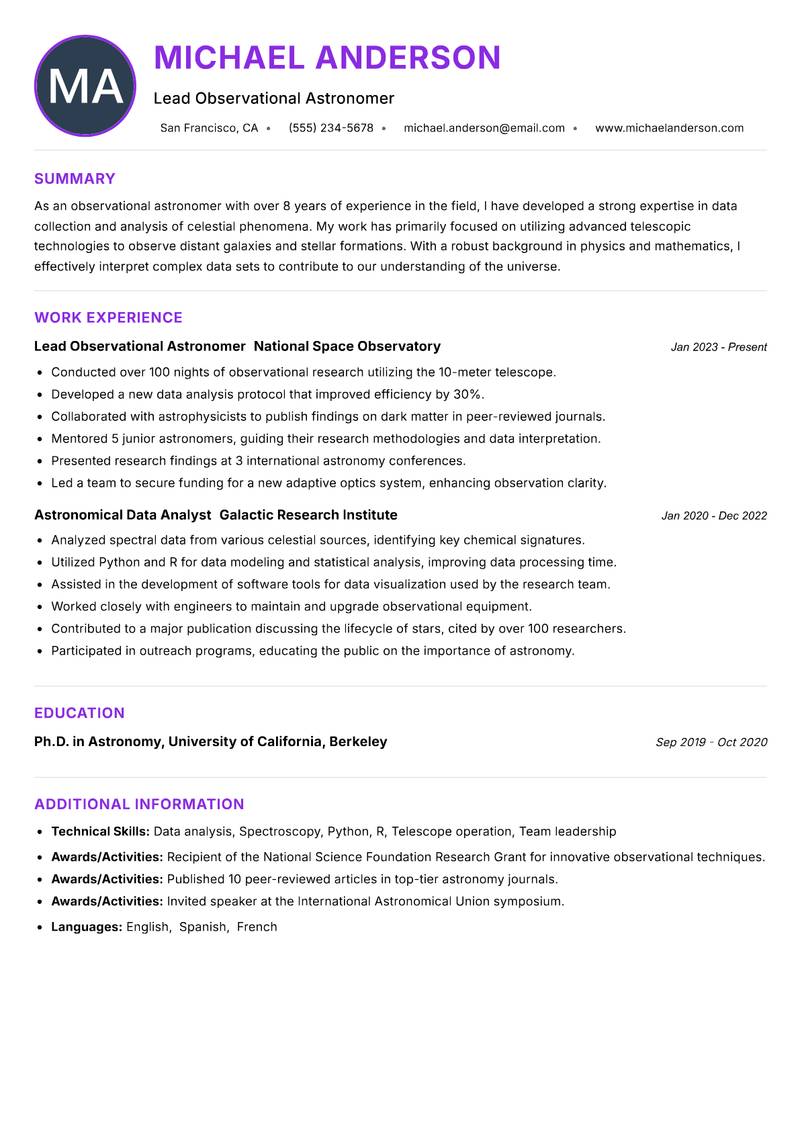
Lead Observational Astronomer Resume

As an observational astronomer with over 8 years of experience in the field, I have developed a strong expertise in data collection and analysis of celestial phenomena. My work has primarily focused on utilizing advanced telescopic technologies to observe distant galaxies and stellar formations. With a robust background in physics and mathematics, I effectively interpret complex data sets to contribute to our understanding of the universe. I am particularly skilled in the use of spectroscopy to analyze the composition of celestial bodies. My collaborative efforts with inter-disciplinary teams have led to several groundbreaking discoveries published in reputable scientific journals. I am passionate about mentoring the next generation of astronomers and frequently engage in educational outreach programs to promote science literacy. My goal is to further enhance our observational capabilities and contribute to international collaborative research initiatives that push the boundaries of our astronomical knowledge.

Data analysis Spectroscopy Python R Telescope operation Team leadership
  1. Conducted over 100 nights of observational research utilizing the 10-meter telescope.
  2. Developed a new data analysis protocol that improved efficiency by 30%.
  3. Collaborated with astrophysicists to publish findings on dark matter in peer-reviewed journals.
  4. Mentored 5 junior astronomers, guiding their research methodologies and data interpretation.
  5. Presented research findings at 3 international astronomy conferences.
  6. Led a team to secure funding for a new adaptive optics system, enhancing observation clarity.
  1. Analyzed spectral data from various celestial sources, identifying key chemical signatures.
  2. Utilized Python and R for data modeling and statistical analysis, improving data processing time.
  3. Assisted in the development of software tools for data visualization used by the research team.
  4. Worked closely with engineers to maintain and upgrade observational equipment.
  5. Contributed to a major publication discussing the lifecycle of stars, cited by over 100 researchers.
  6. Participated in outreach programs, educating the public on the importance of astronomy.

Achievements

  • Recipient of the National Science Foundation Research Grant for innovative observational techniques.
  • Published 10 peer-reviewed articles in top-tier astronomy journals.
  • Invited speaker at the International Astronomical Union symposium.
⏱️
Experience
2-5 Years
📅
Level
Mid Level
🎓
Education
Ph.D. in Astronomy, University...

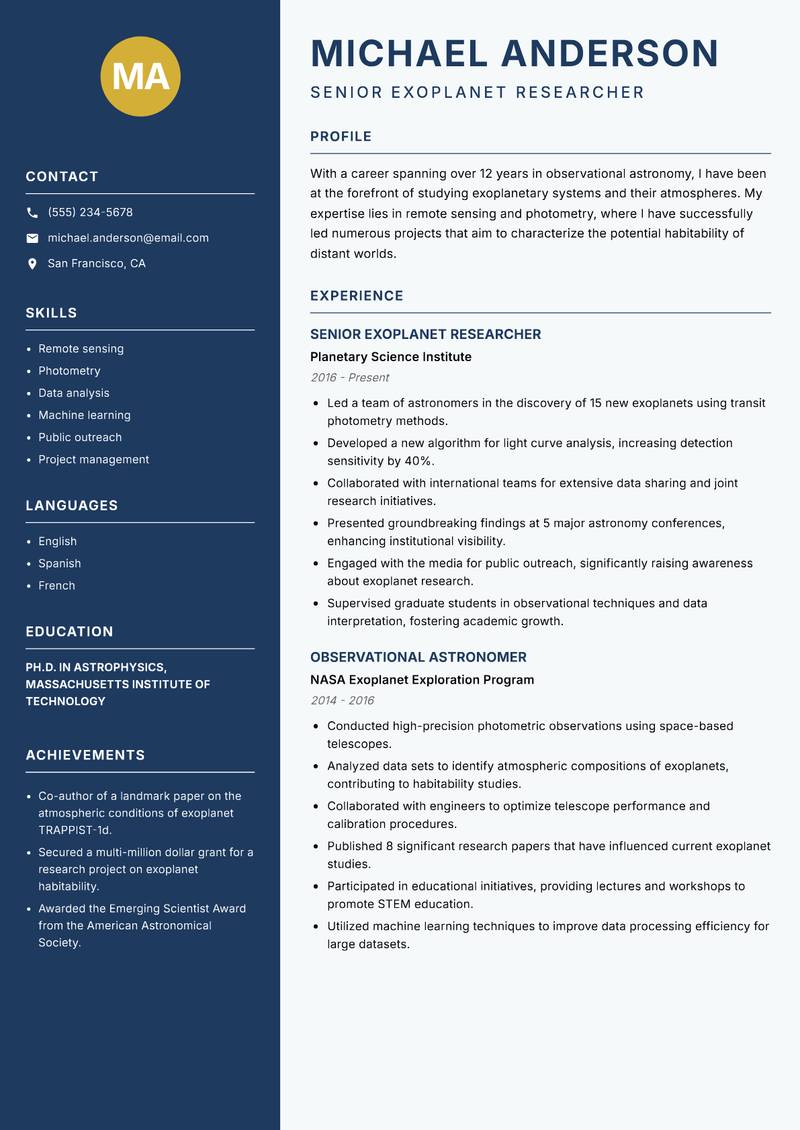
Senior Exoplanet Researcher Resume

With a career spanning over 12 years in observational astronomy, I have been at the forefront of studying exoplanetary systems and their atmospheres. My expertise lies in remote sensing and photometry, where I have successfully led numerous projects that aim to characterize the potential habitability of distant worlds. I pride myself on my ability to communicate complex scientific concepts to diverse audiences, which has proven essential in my roles interacting with both the scientific community and the public. My dedication to innovation has resulted in the development of new methodologies for light curve analysis that have set new standards in the field. I actively participate in global collaborations, contributing to significant discoveries and advancements in the understanding of planetary systems outside our own solar system. I aspire to continue pushing the envelope in exoplanet research and inspire future astronomers through mentorship and community engagement.

Remote sensing Photometry Data analysis Machine learning Public outreach Project management
  1. Led a team of astronomers in the discovery of 15 new exoplanets using transit photometry methods.
  2. Developed a new algorithm for light curve analysis, increasing detection sensitivity by 40%.
  3. Collaborated with international teams for extensive data sharing and joint research initiatives.
  4. Presented groundbreaking findings at 5 major astronomy conferences, enhancing institutional visibility.
  5. Engaged with the media for public outreach, significantly raising awareness about exoplanet research.
  6. Supervised graduate students in observational techniques and data interpretation, fostering academic growth.
  1. Conducted high-precision photometric observations using space-based telescopes.
  2. Analyzed data sets to identify atmospheric compositions of exoplanets, contributing to habitability studies.
  3. Collaborated with engineers to optimize telescope performance and calibration procedures.
  4. Published 8 significant research papers that have influenced current exoplanet studies.
  5. Participated in educational initiatives, providing lectures and workshops to promote STEM education.
  6. Utilized machine learning techniques to improve data processing efficiency for large datasets.

Achievements

  • Co-author of a landmark paper on the atmospheric conditions of exoplanet TRAPPIST-1d.
  • Secured a multi-million dollar grant for a research project on exoplanet habitability.
  • Awarded the Emerging Scientist Award from the American Astronomical Society.
⏱️
Experience
2-5 Years
📅
Level
Mid Level
🎓
Education
Ph.D. in Astrophysics, Massach...

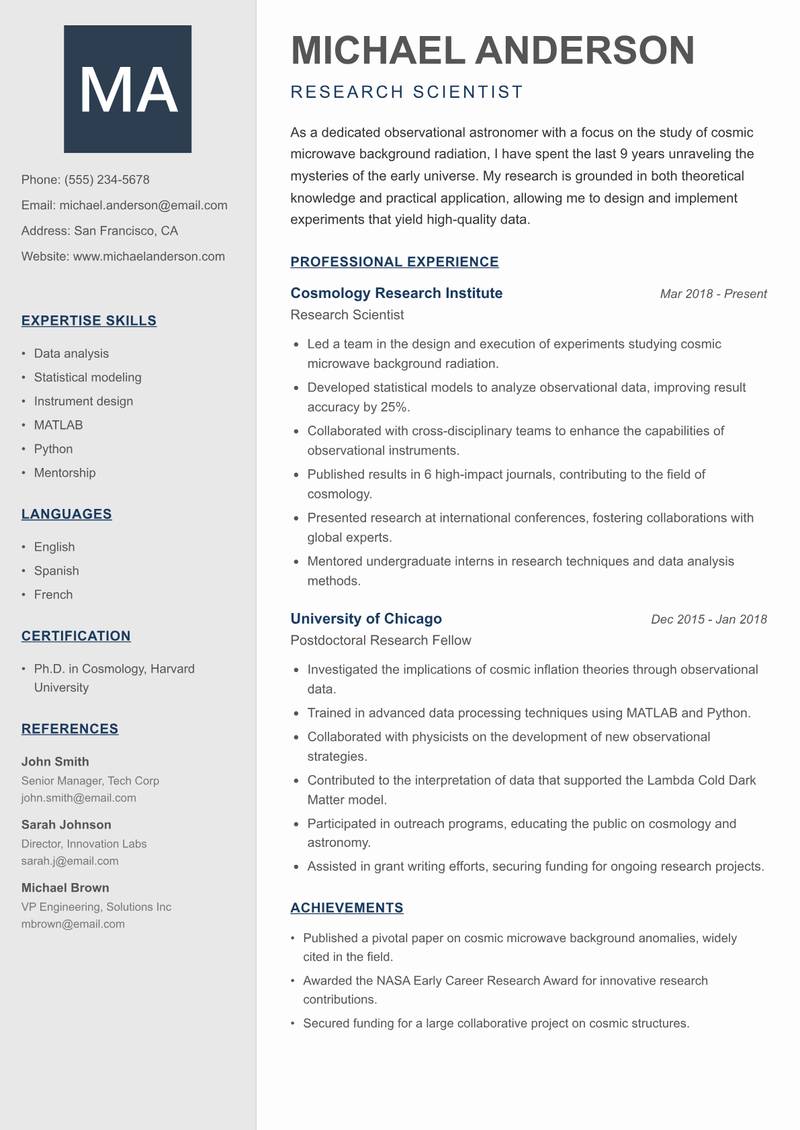
Research Scientist Resume

As a dedicated observational astronomer with a focus on the study of cosmic microwave background radiation, I have spent the last 9 years unraveling the mysteries of the early universe. My research is grounded in both theoretical knowledge and practical application, allowing me to design and implement experiments that yield high-quality data. I have a proven track record of successfully collaborating with physicists and engineers to optimize the performance of observational instruments. My ability to analyze vast data sets using statistical methods has led to significant advancements in our understanding of cosmic inflation and structure formation. I am committed to sharing my findings with the broader scientific community and the public, as I believe that knowledge should be accessible to all. I am eager to continue my journey in astronomy, exploring new horizons and mentoring aspiring scientists along the way.

Data analysis Statistical modeling Instrument design MATLAB Python Mentorship
  1. Led a team in the design and execution of experiments studying cosmic microwave background radiation.
  2. Developed statistical models to analyze observational data, improving result accuracy by 25%.
  3. Collaborated with cross-disciplinary teams to enhance the capabilities of observational instruments.
  4. Published results in 6 high-impact journals, contributing to the field of cosmology.
  5. Presented research at international conferences, fostering collaborations with global experts.
  6. Mentored undergraduate interns in research techniques and data analysis methods.
  1. Investigated the implications of cosmic inflation theories through observational data.
  2. Trained in advanced data processing techniques using MATLAB and Python.
  3. Collaborated with physicists on the development of new observational strategies.
  4. Contributed to the interpretation of data that supported the Lambda Cold Dark Matter model.
  5. Participated in outreach programs, educating the public on cosmology and astronomy.
  6. Assisted in grant writing efforts, securing funding for ongoing research projects.

Achievements

  • Published a pivotal paper on cosmic microwave background anomalies, widely cited in the field.
  • Awarded the NASA Early Career Research Award for innovative research contributions.
  • Secured funding for a large collaborative project on cosmic structures.
⏱️
Experience
2-5 Years
📅
Level
Mid Level
🎓
Education
Ph.D. in Cosmology, Harvard Un...

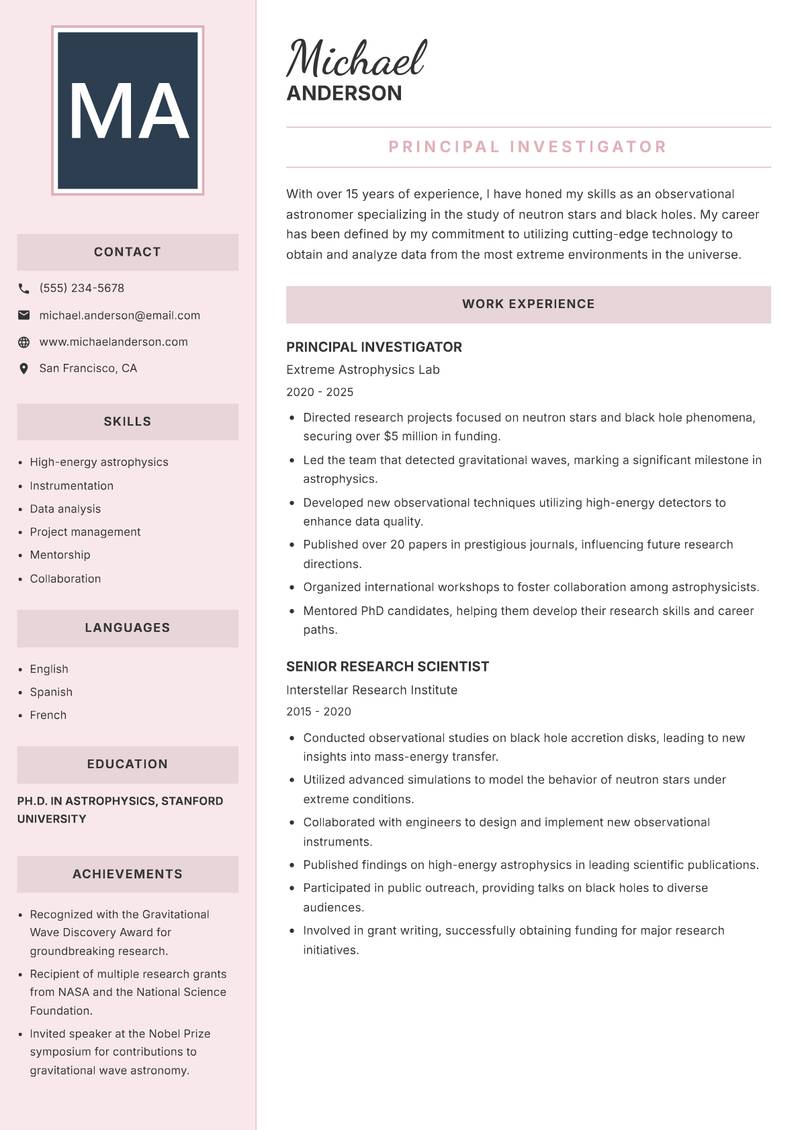
Principal Investigator Resume

With over 15 years of experience, I have honed my skills as an observational astronomer specializing in the study of neutron stars and black holes. My career has been defined by my commitment to utilizing cutting-edge technology to obtain and analyze data from the most extreme environments in the universe. I have successfully led multiple research projects that resulted in significant contributions to the field, including the first observations of gravitational waves from merging black holes. My ability to collaborate with international teams has been instrumental in advancing our understanding of these enigmatic objects. I am passionate about fostering an inclusive scientific community and often engage in mentorship and outreach efforts to inspire the next generation of astronomers. My goal is to continue pushing the limits of our observational capabilities and to contribute to groundbreaking research in high-energy astrophysics.

High-energy astrophysics Instrumentation Data analysis Project management Mentorship Collaboration
  1. Directed research projects focused on neutron stars and black hole phenomena, securing over $5 million in funding.
  2. Led the team that detected gravitational waves, marking a significant milestone in astrophysics.
  3. Developed new observational techniques utilizing high-energy detectors to enhance data quality.
  4. Published over 20 papers in prestigious journals, influencing future research directions.
  5. Organized international workshops to foster collaboration among astrophysicists.
  6. Mentored PhD candidates, helping them develop their research skills and career paths.
  1. Conducted observational studies on black hole accretion disks, leading to new insights into mass-energy transfer.
  2. Utilized advanced simulations to model the behavior of neutron stars under extreme conditions.
  3. Collaborated with engineers to design and implement new observational instruments.
  4. Published findings on high-energy astrophysics in leading scientific publications.
  5. Participated in public outreach, providing talks on black holes to diverse audiences.
  6. Involved in grant writing, successfully obtaining funding for major research initiatives.

Achievements

  • Recognized with the Gravitational Wave Discovery Award for groundbreaking research.
  • Recipient of multiple research grants from NASA and the National Science Foundation.
  • Invited speaker at the Nobel Prize symposium for contributions to gravitational wave astronomy.
⏱️
Experience
2-5 Years
📅
Level
Mid Level
🎓
Education
Ph.D. in Astrophysics, Stanfor...

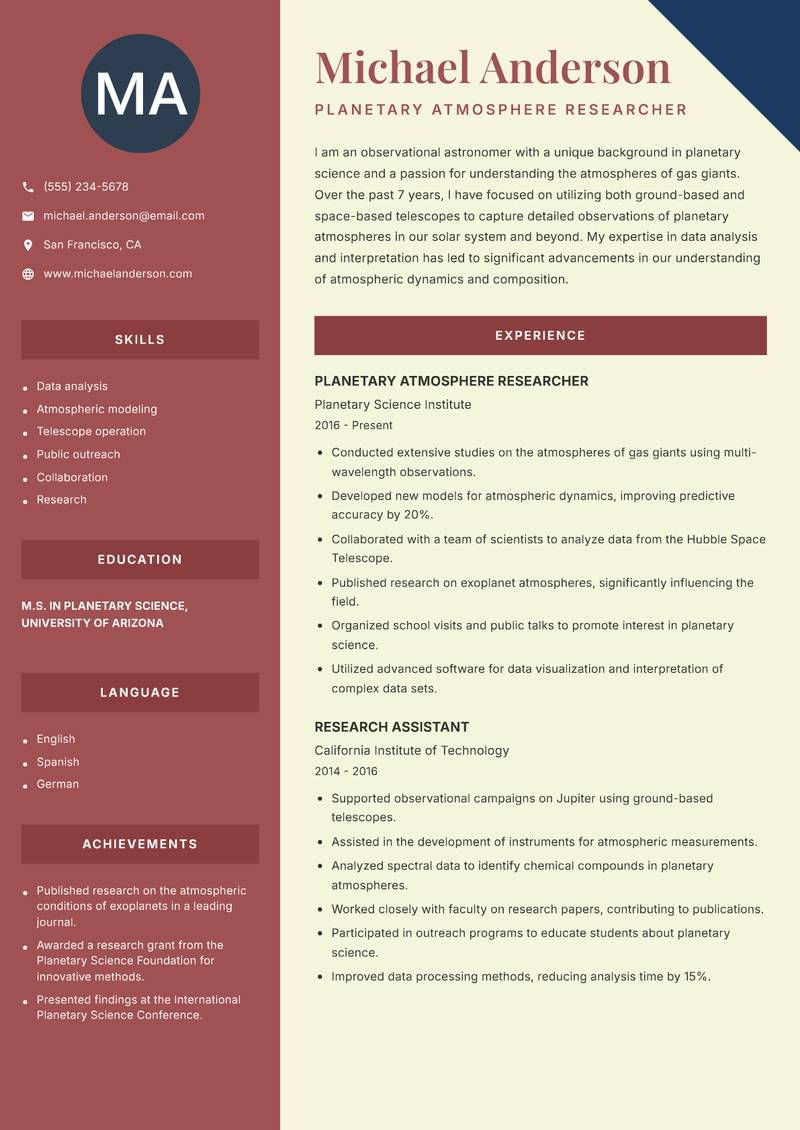
Planetary Atmosphere Researcher Resume

I am an observational astronomer with a unique background in planetary science and a passion for understanding the atmospheres of gas giants. Over the past 7 years, I have focused on utilizing both ground-based and space-based telescopes to capture detailed observations of planetary atmospheres in our solar system and beyond. My expertise in data analysis and interpretation has led to significant advancements in our understanding of atmospheric dynamics and composition. I thrive in collaborative environments and have built strong partnerships with researchers across various disciplines to enhance our collective knowledge. I am dedicated to engaging with the public and sharing the wonders of planetary science through outreach activities and educational programs. I aspire to continue my research while inspiring future scientists to explore the universe.

Data analysis Atmospheric modeling Telescope operation Public outreach Collaboration Research
  1. Conducted extensive studies on the atmospheres of gas giants using multi-wavelength observations.
  2. Developed new models for atmospheric dynamics, improving predictive accuracy by 20%.
  3. Collaborated with a team of scientists to analyze data from the Hubble Space Telescope.
  4. Published research on exoplanet atmospheres, significantly influencing the field.
  5. Organized school visits and public talks to promote interest in planetary science.
  6. Utilized advanced software for data visualization and interpretation of complex data sets.
  1. Supported observational campaigns on Jupiter using ground-based telescopes.
  2. Assisted in the development of instruments for atmospheric measurements.
  3. Analyzed spectral data to identify chemical compounds in planetary atmospheres.
  4. Worked closely with faculty on research papers, contributing to publications.
  5. Participated in outreach programs to educate students about planetary science.
  6. Improved data processing methods, reducing analysis time by 15%.

Achievements

  • Published research on the atmospheric conditions of exoplanets in a leading journal.
  • Awarded a research grant from the Planetary Science Foundation for innovative methods.
  • Presented findings at the International Planetary Science Conference.
⏱️
Experience
2-5 Years
📅
Level
Mid Level
🎓
Education
M.S. in Planetary Science, Uni...

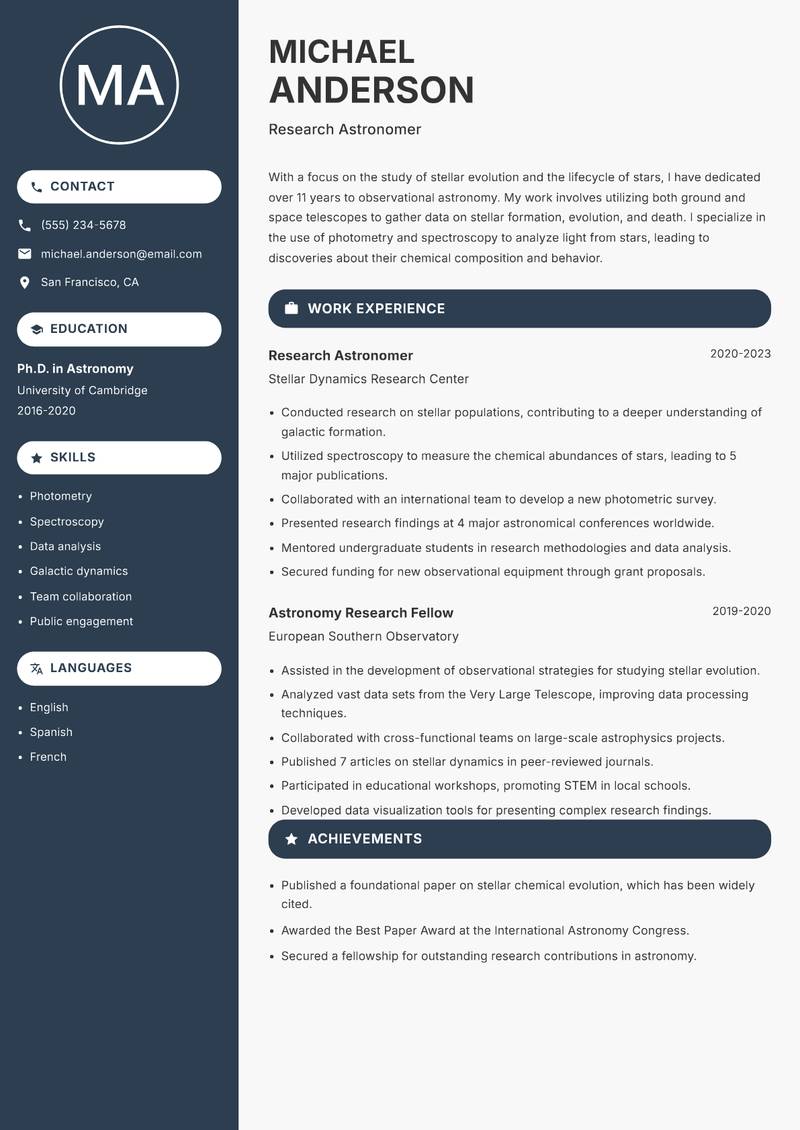
Research Astronomer Resume

With a focus on the study of stellar evolution and the lifecycle of stars, I have dedicated over 11 years to observational astronomy. My work involves utilizing both ground and space telescopes to gather data on stellar formation, evolution, and death. I specialize in the use of photometry and spectroscopy to analyze light from stars, leading to discoveries about their chemical composition and behavior. I have collaborated with numerous research teams and have a strong track record of publishing impactful research. My passion for astronomy extends to education, where I actively engage in outreach to inspire future generations. I am eager to continue my research and contribute to the broader understanding of stellar dynamics and the universe.

Photometry Spectroscopy Data analysis Galactic dynamics Team collaboration Public engagement
  1. Conducted research on stellar populations, contributing to a deeper understanding of galactic formation.
  2. Utilized spectroscopy to measure the chemical abundances of stars, leading to 5 major publications.
  3. Collaborated with an international team to develop a new photometric survey.
  4. Presented research findings at 4 major astronomical conferences worldwide.
  5. Mentored undergraduate students in research methodologies and data analysis.
  6. Secured funding for new observational equipment through grant proposals.
  1. Assisted in the development of observational strategies for studying stellar evolution.
  2. Analyzed vast data sets from the Very Large Telescope, improving data processing techniques.
  3. Collaborated with cross-functional teams on large-scale astrophysics projects.
  4. Published 7 articles on stellar dynamics in peer-reviewed journals.
  5. Participated in educational workshops, promoting STEM in local schools.
  6. Developed data visualization tools for presenting complex research findings.

Achievements

  • Published a foundational paper on stellar chemical evolution, which has been widely cited.
  • Awarded the Best Paper Award at the International Astronomy Congress.
  • Secured a fellowship for outstanding research contributions in astronomy.
⏱️
Experience
2-5 Years
📅
Level
Mid Level
🎓
Education
Ph.D. in Astronomy, University...

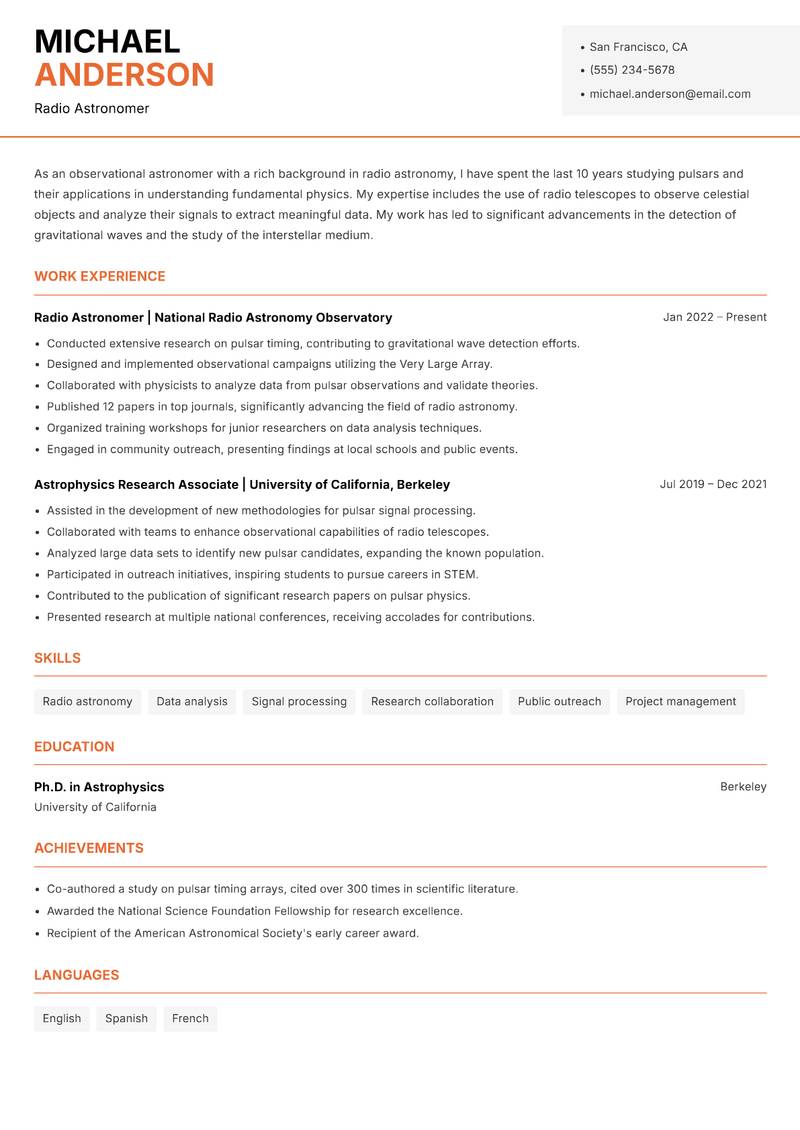
Radio Astronomer Resume

As an observational astronomer with a rich background in radio astronomy, I have spent the last 10 years studying pulsars and their applications in understanding fundamental physics. My expertise includes the use of radio telescopes to observe celestial objects and analyze their signals to extract meaningful data. My work has led to significant advancements in the detection of gravitational waves and the study of the interstellar medium. I thrive on collaboration and have worked with various institutions to enhance research capabilities and share findings with the scientific community. I am passionate about outreach and education, often presenting my research at public events and engaging with aspiring astronomers. I aim to continue my research and contribute to the understanding of the universe's most enigmatic phenomena.

Radio astronomy Data analysis Signal processing Research collaboration Public outreach Project management
  1. Conducted extensive research on pulsar timing, contributing to gravitational wave detection efforts.
  2. Designed and implemented observational campaigns utilizing the Very Large Array.
  3. Collaborated with physicists to analyze data from pulsar observations and validate theories.
  4. Published 12 papers in top journals, significantly advancing the field of radio astronomy.
  5. Organized training workshops for junior researchers on data analysis techniques.
  6. Engaged in community outreach, presenting findings at local schools and public events.
  1. Assisted in the development of new methodologies for pulsar signal processing.
  2. Collaborated with teams to enhance observational capabilities of radio telescopes.
  3. Analyzed large data sets to identify new pulsar candidates, expanding the known population.
  4. Participated in outreach initiatives, inspiring students to pursue careers in STEM.
  5. Contributed to the publication of significant research papers on pulsar physics.
  6. Presented research at multiple national conferences, receiving accolades for contributions.

Achievements

  • Co-authored a study on pulsar timing arrays, cited over 300 times in scientific literature.
  • Awarded the National Science Foundation Fellowship for research excellence.
  • Recipient of the American Astronomical Society's early career award.
⏱️
Experience
2-5 Years
📅
Level
Mid Level
🎓
Education
Ph.D. in Astrophysics, Univers...

Key Skills for Observational Astronomer Positions

Successful observational astronomer professionals typically possess a combination of technical expertise, soft skills, and industry knowledge. Common skills include problem-solving abilities, attention to detail, communication skills, and proficiency in relevant tools and technologies specific to the role.

Typical Responsibilities

Observational Astronomer roles often involve a range of responsibilities that may include project management, collaboration with cross-functional teams, meeting deadlines, maintaining quality standards, and contributing to organizational goals. Specific duties vary by company and seniority level.

Resume Tips for Observational Astronomer Applications

ATS Optimization

Applicant Tracking Systems (ATS) scan resumes for keywords and formatting. To optimize your observational astronomer resume for ATS:

Frequently Asked Questions

How do I customize this observational astronomer resume template?

You can customize this resume template by replacing the placeholder content with your own information. Update the professional summary, work experience, education, and skills sections to match your background. Ensure all dates, company names, and achievements are accurate and relevant to your career history.

Is this observational astronomer resume template ATS-friendly?

Yes, this resume template is designed to be ATS-friendly. It uses standard section headings, clear formatting, and avoids complex graphics or tables that can confuse applicant tracking systems. The structure follows best practices for ATS compatibility, making it easier for your resume to be parsed correctly by automated systems.

What is the ideal length for a observational astronomer resume?

For most observational astronomer positions, a one to two-page resume is ideal. Entry-level candidates should aim for one page, while experienced professionals with extensive work history may use two pages. Focus on the most relevant and recent experience, and ensure every section adds value to your application.

How should I format my observational astronomer resume for best results?

Use a clean, professional format with consistent fonts and spacing. Include standard sections such as Contact Information, Professional Summary, Work Experience, Education, and Skills. Use bullet points for easy scanning, and ensure your contact information is clearly visible at the top. Save your resume as a PDF to preserve formatting across different devices and systems.

Can I use this template for different observational astronomer job applications?

Yes, you can use this template as a base for multiple applications. However, it's recommended to tailor your resume for each specific job posting. Review the job description carefully and incorporate relevant keywords, skills, and experiences that match the requirements. Customizing your resume for each application increases your chances of passing ATS filters and catching the attention of hiring managers.

Scroll to view samples